

Broker Globale Piattaforma di Verifica Regolamentare
WikiFX
English
简体中文
繁體中文
English
Pусский
日本語
ภาษาไทย
Tiếng Việt
Bahasa Indonesia
Español
हिन्दी
Filippiiniläinen
Français
Deutsch
Português
Türkçe
한국어
العربية
ETO Markets Trend Watch: Walsh Shock Triggers Cross-Asset Liquidity Repricing
Sommario:On January 30, global markets were hit by an unexpected “Walsh Shock.”Disruptions in expectations surrounding Federal Reserve leadership triggered a rapid reassessment of the monetary policy path and
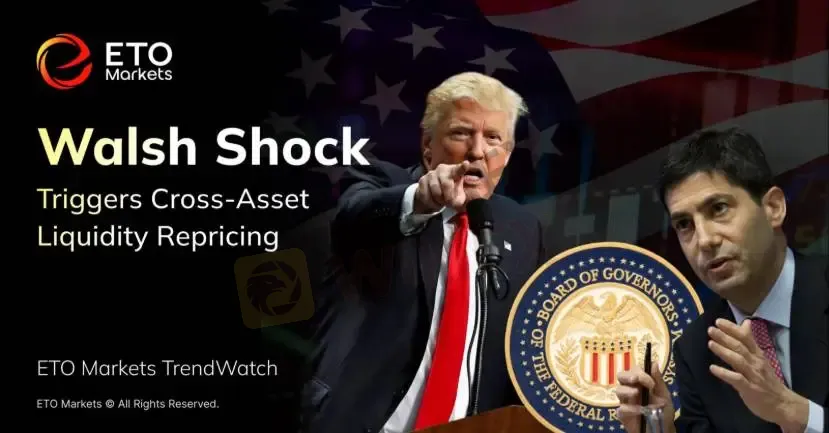
On January 30, global markets were hit by an unexpected “Walsh Shock.”
Disruptions in expectations surrounding Federal Reserve leadership triggered a rapid reassessment of the monetary policy path and the liquidity outlook. Precious metals suffered historic single- day declines, the U.S. dollar strengthened sharply, and multiple asset classes fell simultaneously as risk premia unwound raqidly.
ETO Markets reviews how crypto, gold, silver, equities, and other assets repriced through price action and cross-asset linkages during the shock.
Crypto Leads Risk Unwinding
Cryptocurrencies, as high volatility and high leverage assets, led the derisking process and adjusted far faster than traditional risk assets.
On January 29, Bitcoin fell below USD 85,000 with a single day drop exceeding 5%, while Ethereum and other major assets declined in tandem. More than 220,000 traders were liquidated within 24 hours, totaling USD 10 billion.
On January 30, Bitcoins slide deepened, widening its 24-hour loss to 6.28%, with liquidations rising above 270,000 traders and overall losses reaching roughly USD 12 billion.
Precious Metals Suffer Liquidity Reversal
Precious metals saw an extreme liquidity driven reversal on January 30.
Spot gold plunged over 12% intraday, briefly breaking below USD 4,700 before closing down 9.25% at USD 4,880.03 per ounce. Silver experienced even more violent swings, dropping below USD 75 with intraday losses exceeding 35%, triggering forced selling.
Given silvers heavier trend-following and leveraged positioning in the preceding rally, its price retracement was significantly amplified once liquidity assumptions came under scrutiny.
Equities Absorb Shock Steadily
U.S. equities were affected by the volatility in precious metals, though the impact remained contained and did not evolve into systemic selling.
On the day of the shock, the Dow fell 0.36%, the S&P 500 declined 0.43%, and the Nasdaq dropped 0.94%. In contrast, major European indices including the DAX, CAC 40, and FTSE 100 posted modest gains.
Equity markets reflected risk repricing and sector rotation rather than a broad deterioration in growth expectations.
Oil Holds Its Range
Crude oil was influenced mainly by sentiment spillover and did not undergo a fundamental decline.
On January 30, crude oil prices stayed within a narrow range, with WTI front-month futures down 0.32% at USD 65.51 per barrel and Brent futures slipping 0.03% to USD 70.69 per barrel.
Compared with high volatility assets such as gold and silver, oil prices showed notable restraint without breaking trend.
Dollar Regains Pricing Power
The U.S. dollar strengthened sharply as liquidity expectations shifted higher.
The Dollar Index gained 0.73% to close at 96.989 in New York, with USD/JPY rising to 154.56 and the dollar appreciating against the Swiss franc, Canadian dollar, and Swedish krona.
The Walsh Shock ultimately prompted a recalibration of the Feds liquidity path, allowing the dollar to reassert itself as the anchor for cross-asset repricing.
Trillions in Market Value Lost
Approximately USD 3.5 trillion in precious metal market value evaporated, exceeding the annual GDP of France, Italy, or Canada. As a standalone “economy,” the loss would rank seventh globally.
It represents about 5% of total U.S. equity market capitalization, nearly 90% of the UK stock market, and surpasses the combined wealth of the worlds ten richest individuals.
Liquidity Assumptions Recalibrated
Overall, the Walsh Shock was not a sudden shift in economic fundamentals but a concentrated repricing around monetary tools and liquidity dynamics. Precious metals and cryptocurrencies absorbed the sharpest liquidity and leverage unwinding, while the dollar regained pricing dominance, widening asset differentiation.
ETO Markets will continue to track policy expectations, liquidity conditions, and cross-asset behavior to help investors identify critical pricing signals in a high volatility environment.
Disclaimer
The information contained herein is for general reference only and does not constitute investment advice, a solicitation, or an offer to buy or sell any financial products.
ETO Markets does not guarantee the accuracy, completeness, or timeliness of the information and shall not be liable for any losses incurred from reliance on such content.
Disclaimer:
Le opinioni di questo articolo rappresentano solo le opinioni personali dell’autore e non costituiscono consulenza in materia di investimenti per questa piattaforma. La piattaforma non garantisce l’accuratezza, la completezza e la tempestività delle informazioni relative all’articolo, né è responsabile delle perdite causate dall’uso o dall’affidamento delle informazioni relative all’articolo.
WikiFX Trader
GO Markets
Sotto supervisione
EC markets
Sotto supervisione
VT Markets
Sotto supervisione
GTCFX
Sotto supervisione
TICKMILL
Sotto supervisione
ZFX
Sotto supervisione
GO Markets
Sotto supervisione
EC markets
Sotto supervisione
VT Markets
Sotto supervisione
GTCFX
Sotto supervisione
TICKMILL
Sotto supervisione
ZFX
Sotto supervisione
WikiFX Trader
GO Markets
Sotto supervisione
EC markets
Sotto supervisione
VT Markets
Sotto supervisione
GTCFX
Sotto supervisione
TICKMILL
Sotto supervisione
ZFX
Sotto supervisione
GO Markets
Sotto supervisione
EC markets
Sotto supervisione
VT Markets
Sotto supervisione
GTCFX
Sotto supervisione
TICKMILL
Sotto supervisione
ZFX
Sotto supervisione
Rate Calc
USD

CNY
Tasso di cambio attuale:0
inserisci l'importo
USD
A disposizione
CNY
Calcolare 