


Broker Globale Piattaforma di Verifica Regolamentare
WikiFX
Italiano
简体中文
繁體中文
English
Pусский
日本語
ภาษาไทย
Tiếng Việt
Bahasa Indonesia
Español
हिन्दी
Filippiiniläinen
Français
Deutsch
Português
Türkçe
한국어
العربية
اردو
DBG Markets | What is PMI Data? Does it Matter to Traders? Part 1
Sommario:What is PMI Data? Does it Matter to Traders?In the fast-moving world of financial markets, waiting for GDP data is often like reading yesterdays newspaper—it tells you where the economy was, not where

In the fast-moving world of financial markets, waiting for GDP data is often like reading yesterday's newspaper—it tells you where the economy was, not where it‘s going. This is why PMI (Purchasing Managers’ Index) data is one of the most closely watched indicators on any trader's economic calendar.
As a "leading indicator," PMI provides a real-time pulse of business sentiment, offering early insights into economic trends before they show up in lagging data. In the following article, DBG Markets breaks down how to read this "economic crystal ball" and how this may have impact to your trading.
1. What exactly is PMI?
PMI stands for Purchasing Managers Index. It is a key indicator of economic activity in both the manufacturing and services sectors. Compiled through monthly surveys of purchasing managers, it reflects changes in business conditions over a specific period.
The logic is simple: Purchasing managers are at the front lines of the supply chain. They are the first to know when new orders increase, when inventories are piling up, or when hiring is freezing. When they are optimistic, the economy usually follows.
The PMI originated in the United States and is now widely used across major economies, including the EU and Asia.
2. How is PMI Calculated?
While methodologies may vary slightly between countries and regions, the core structure of PMI compilation is broadly similar.
Taking the US for example, while several organizations track PMI globally (such as S&P Global), the most recognized figures for the U.S. economy are published by the Institute for Supply Management (ISM).
The PMI is calculated through survey questionnaires. The compilers distribute surveys across various industries—covering businesses of all sizes—and collect data based on specific economic components. The data is then used to calculate a diffusion index for each sector.
Finally, these sector-specific indices are weighted according to their contribution to GDP to derive the overall PMI.
3. Two Distinct PMI – Service & Manufacturing PMI
In most cases, PMI releases in two distinct reports:
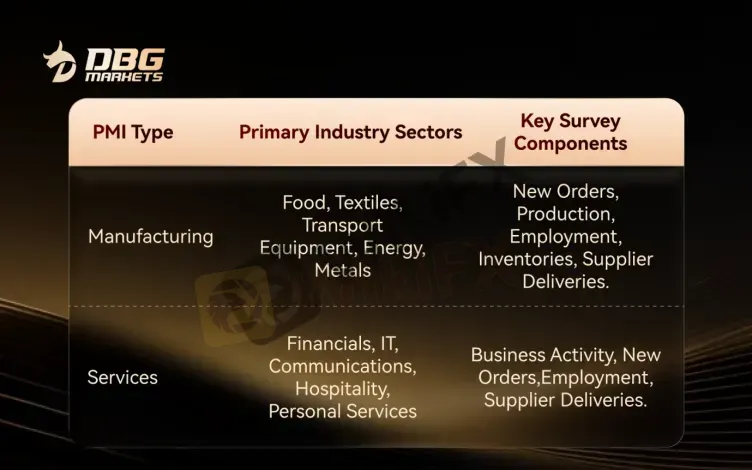
· Manufacturing PMI: Focuses on the industrial and factory sectors.
· Services PMI: Focuses on the vast non-manufacturing sectors (finance, IT, hospitality, etc.).
These indices are calculated using a Diffusion Index. Survey responses are weighted based on their contribution to GDP. Here is a breakdown of what goes into the calculation:
Disclaimer:
Le opinioni di questo articolo rappresentano solo le opinioni personali dell’autore e non costituiscono consulenza in materia di investimenti per questa piattaforma. La piattaforma non garantisce l’accuratezza, la completezza e la tempestività delle informazioni relative all’articolo, né è responsabile delle perdite causate dall’uso o dall’affidamento delle informazioni relative all’articolo.
WikiFX Trader
EBC FINANCIAL GROUP
Sotto supervisione
FOREX.com
Supervisione del paese
vantage
Sotto supervisione
GTCFX
Sotto supervisione
Axi
Sotto supervisione
Exness
Sotto supervisione
EBC FINANCIAL GROUP
Sotto supervisione
FOREX.com
Supervisione del paese
vantage
Sotto supervisione
GTCFX
Sotto supervisione
Axi
Sotto supervisione
Exness
Sotto supervisione
WikiFX Trader
EBC FINANCIAL GROUP
Sotto supervisione
FOREX.com
Supervisione del paese
vantage
Sotto supervisione
GTCFX
Sotto supervisione
Axi
Sotto supervisione
Exness
Sotto supervisione
EBC FINANCIAL GROUP
Sotto supervisione
FOREX.com
Supervisione del paese
vantage
Sotto supervisione
GTCFX
Sotto supervisione
Axi
Sotto supervisione
Exness
Sotto supervisione
Rate Calc
USD

CNY
Tasso di cambio attuale:0
inserisci l'importo
USD
A disposizione
CNY
Calcolare 