

Broker Globale Piattaforma di Verifica Regolamentare
WikiFX
English
简体中文
繁體中文
English
Pусский
日本語
ภาษาไทย
Tiếng Việt
Bahasa Indonesia
Español
हिन्दी
Filippiiniläinen
Français
Deutsch
Português
Türkçe
한국어
العربية
DBG Markets | Soaring US Treasury Yields: Its Impact on Markets Part 1
Sommario:Soaring US Treasury Yields: Its Impact on MarketsOver the past few weeks, gold bulls have felt a sudden chill. After an epic, record-breaking rally throughout late 2025 and early 2026 that pushed pric

Soaring US Treasury Yields: Its Impact on Markets
Over the past few weeks, gold bulls have felt a sudden chill. After an epic, record-breaking rally throughout late 2025 and early 2026 that pushed prices toward the historic $5,000-mark, Gold has begun to pull back. Many traders are left asking: With geopolitical tensions still simmering, why has gold stopped climbing and even on a free falls?
The answer isn't found in the geopolitical headlines; it is found in the yield curve. Today, DBG Markets breaks down the primary driver of current market volatility: US Treasury Yields.
1. What is US Treasury Yield?
In simple terms, a US Treasury Yield is the interest rate the U.S. government pays to investors who lend them money by purchasing government bonds. It is essentially the “price” of borrowing money for the government.
Because these bonds are backed by the “full faith and credit” of the U.S. government, they are considered the “risk-free” benchmark for the entire global financial system.
· Yield Factors: Yields vary depending on the length of the loan (e.g., 2-year, 10-year, or 30-year). In the current market, traders pay the closest attention to the 10-Year Yield (US10Y), as it dictates the cost of mortgages, corporate loans, and the general attractiveness of the U.S. Dollar.
· Yield Explained (Example): Imagine you buy a 2-year Treasury bond with a face value of $1,000 and a 3.5% yield.
The government is promising to pay you $35 in interest every year for two years. At the end of the two years, you get your $1,000 back. In a stable market, that 3.5% is your “guaranteed” return for locking up your cash.
2. Treasury Bond Price & Bond Yield
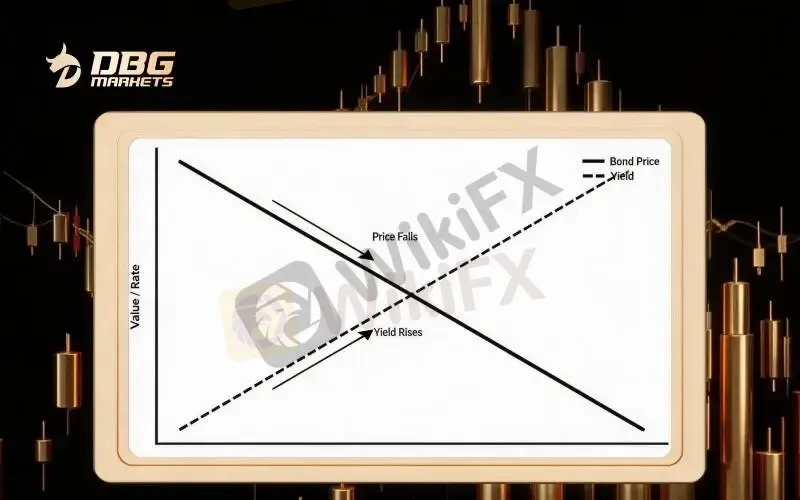
It is crucial to remember that bond prices and yields are two different concepts, and they move in opposite directions. This is the most fundamental rule of the bond market.
· Selling Bonds: When investors sell off their bonds, the market supply increases, causing the Bond Price to fall and the Yield to rise.
· Buying Bonds: When investors rush to buy bonds, the high demand drives the Bond Price up and causes the Yield to fall.
Understanding the bond market is essential for any gold trader. The most fundamental rule to remember is that bond prices and yields move in opposite directions.
Why do they move inversely? Think of a bond as a fixed contract. If your bond pays a fixed $35 (3.5% coupon), but the market suddenly shifts and new bonds start paying $50 (5.0%), no one will buy your 3.5% bond for its original price.
To sell your bond, you must lower the price. Because the new buyer still receives that same $35 payment but paid less for the bond itself, their effective interest rate (the yield) increases to match current market conditions.
3. Why Are Yields Surging in March 2026?
Beyond the movement in bond prices, there are several macroeconomic “engines” driving this surge. To understand the current environment, we must look at the mechanics of interest rates and shifting market expectations.
Treasury yields generally follow the path of the Federal Funds Rate. This means that the demand for bonds is primarily based on the market's expectation of the Fed‘s future policy. Essentially, a Treasury yield represents the market’s “consensus forecast” of what the average interest rate will be over the life of that bond.
When the Fed keeps interest rates high to combat persistent inflation, new bonds are issued with higher coupon rates. To stay competitive, the yields on existing (older) bonds must rise to match these new market rates. This “yield adjustment” occurs as investors sell off older, lower-paying bonds, driving their market prices down until their effective yield becomes attractive to new buyers.
As of March 2026, the primary driver is the Federal Reserve's “Higher for Longer” stance:
· Inflation “Stickiness”: Despite the Fed's aggressive efforts, inflation has remained stubborn, largely driven by structural high energy costs and supply chain shifts. This has forced markets to “price out” any hopes of immediate rate cuts, keeping yields pinned at multi-year highs—currently hovering between 4.5%–4.8%.
· The Supply Factor: To fund heavy government spending and manage fiscal deficits, the U.S. Treasury continues to issue a massive volume of new debt. This “supply glut” of bonds requires higher yields to attract enough global buyers to absorb the debt. This imbalance between high supply and cautious demand puts consistent upward pressure on the bond yields.
Disclaimer:
Le opinioni di questo articolo rappresentano solo le opinioni personali dell’autore e non costituiscono consulenza in materia di investimenti per questa piattaforma. La piattaforma non garantisce l’accuratezza, la completezza e la tempestività delle informazioni relative all’articolo, né è responsabile delle perdite causate dall’uso o dall’affidamento delle informazioni relative all’articolo.
WikiFX Trader
STARTRADER
Sotto supervisione
IC Markets Global
Sotto supervisione
GTCFX
Sotto supervisione
FXTM
Sotto supervisione
GO Markets
Sotto supervisione
EC markets
Sotto supervisione
STARTRADER
Sotto supervisione
IC Markets Global
Sotto supervisione
GTCFX
Sotto supervisione
FXTM
Sotto supervisione
GO Markets
Sotto supervisione
EC markets
Sotto supervisione
WikiFX Trader
STARTRADER
Sotto supervisione
IC Markets Global
Sotto supervisione
GTCFX
Sotto supervisione
FXTM
Sotto supervisione
GO Markets
Sotto supervisione
EC markets
Sotto supervisione
STARTRADER
Sotto supervisione
IC Markets Global
Sotto supervisione
GTCFX
Sotto supervisione
FXTM
Sotto supervisione
GO Markets
Sotto supervisione
EC markets
Sotto supervisione
Rate Calc
USD

CNY
Tasso di cambio attuale:0
inserisci l'importo
USD
A disposizione
CNY
Calcolare 