

Broker Globale Piattaforma di Verifica Regolamentare
WikiFX
English
简体中文
繁體中文
English
Pусский
日本語
ภาษาไทย
Tiếng Việt
Bahasa Indonesia
Español
हिन्दी
Filippiiniläinen
Français
Deutsch
Português
Türkçe
한국어
العربية
U.S.–Iran Conflict Enters Critical Week as Geopolitical Order Undergoes Structural Shift
Sommario:[Figure 1: U.S.–Iran Conflict Overview]As the U.S.–Iran conflict enters a decisive week, the global geopolitical landscape is undergoing a fundamental realignment. President Trump‘s public rupture wit
[Figure 1: U.S.–Iran Conflict Overview]
As the U.S.–Iran conflict enters a decisive week, the global geopolitical landscape is undergoing a fundamental realignment. President Trump‘s public rupture with the traditional NATO alliance system, the escalation of Iranian retaliation following the death of senior official Ali Larijani, and logistical vulnerabilities exposed in the U.S. Navy’s USS Gerald R. Ford carrier group have collectively pushed the world toward a fragmented and highly volatile wartime environment lacking coordinated leadership.
The most significant political signal this week comes from Trumps ultimatum to NATO and key Asia-Pacific allies (Japan, South Korea, and Australia):
Threat of U.S. withdrawal from NATO: Trump stated that the U.S. “no longer needs nor desires” allied support and suggested he could bypass Congress to exit NATO. This marks a structural fracture in the post–World War II Western collective security framework.
Allied strategic distancing: France, Germany, Canada, and the Netherlands have all declined participation in military operations. This reflects Europes shift toward strategic autonomy, balancing energy dependence and regional stability while avoiding entanglement in a potentially prolonged U.S.–Israel campaign against Iran.
Following the loss of two senior officials, Iran has effectively closed the door on negotiations. The newly appointed Supreme Leader, Mojtaba Khamenei, has rejected ceasefire proposals and instead demanded war reparations from the U.S. and Israel. Iran has already filled key leadership positions, signaling a transition toward a wartime governance structure.
Irans retaliatory actions have intensified significantly, including:
A single-day launch of 100 drones targeting Saudi Arabia
Coordinated ballistic missile and drone strikes on the UAE
These attacks have set new operational records and are precisely aimed at Middle Eastern energy infrastructure. This strategy goes beyond military retaliation, seeking to weaponize energy supply disruptions to erode Western political resolve.
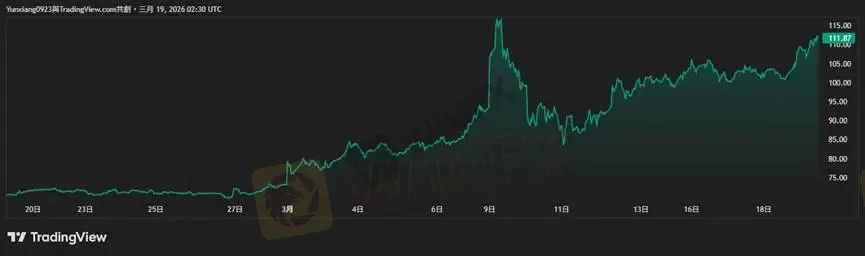
[Figure 2: Brent Crude Oil H1 Chart Analysis]
Brent crude has closed above $100 per barrel for four consecutive sessions, reaching its highest level in more than three years. Energy prices are no longer driven by traditional supply-demand fundamentals but are instead dictated by the breakdown of security norms in the Strait of Hormuz.
Irans parliament speaker explicitly stated that “the strait will not return to its pre-war state,” implying that even after the conflict ends, global energy logistics will continue to carry structurally elevated security premiums and insurance costs.
Analyst Insights
Energy and Inflation Dynamics
As rising energy costs transmit through to end consumers, the Federal Reserve faces an increasingly acute policy dilemma between inflation control and recession risk.
Shift in Safe-Haven Assets
With growing fractures between the U.S. and its allies, the traditional U.S. dollar safe-haven narrative is partially giving way to assets with censorship resistance characteristics, such as Bitcoin (BTC) and gold.
Defense Sector Divergence
Market focus is shifting away from heavy offensive weapon systems toward counter-drone technologies, as well as industries related to rapid repair, logistics, and battlefield resilience.
[Figure 3: Gold H1 Chart Analysis]
Key support: $4,800
A break below this level could open further downside toward $4,750–$4,700
Key resistance: $4,900 and $5,000
Failure to reclaim $4,900 suggests continued downside pressure
Risk Disclaimer
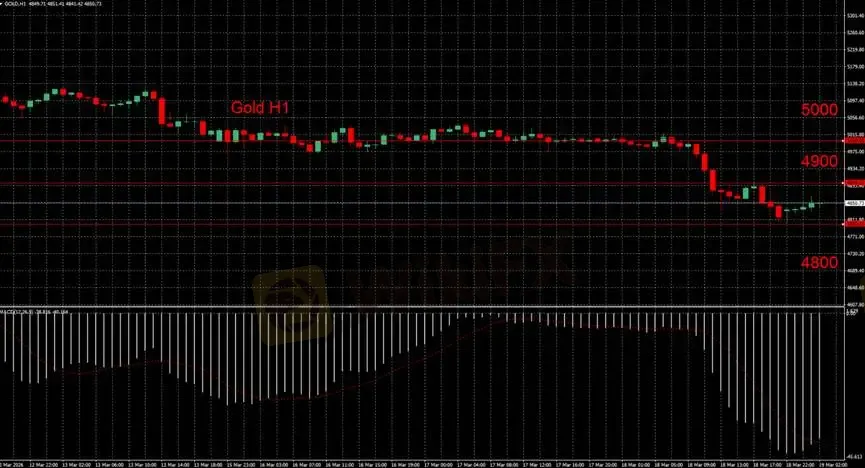
Gold on the H1 timeframe has broken decisively to the downside. After falling below the prior consolidation range at $5,000, prices accelerated lower, dropping beneath $4,900 and testing support in the $4,800–$4,850 range.
The broader structure has transitioned from consolidation into a continuation of a bearish trend, with progressively lower lows confirming short-term weakness.
From a tactical perspective, the market remains bearish on rebounds unless price can decisively recover above the $5,000 level.
The above views, analysis, research, price levels, and other information are provided for general market commentary only and do not represent the position of this platform. All readers should independently assess risks and exercise caution when making investment decisions.
Disclaimer:
Le opinioni di questo articolo rappresentano solo le opinioni personali dell’autore e non costituiscono consulenza in materia di investimenti per questa piattaforma. La piattaforma non garantisce l’accuratezza, la completezza e la tempestività delle informazioni relative all’articolo, né è responsabile delle perdite causate dall’uso o dall’affidamento delle informazioni relative all’articolo.
WikiFX Trader
EBC FINANCIAL GROUP
Sotto supervisione
FXTM
Sotto supervisione
IC Markets Global
Sotto supervisione
VT Markets
Sotto supervisione
ZFX
Sotto supervisione
EC markets
Sotto supervisione
EBC FINANCIAL GROUP
Sotto supervisione
FXTM
Sotto supervisione
IC Markets Global
Sotto supervisione
VT Markets
Sotto supervisione
ZFX
Sotto supervisione
EC markets
Sotto supervisione
WikiFX Trader
EBC FINANCIAL GROUP
Sotto supervisione
FXTM
Sotto supervisione
IC Markets Global
Sotto supervisione
VT Markets
Sotto supervisione
ZFX
Sotto supervisione
EC markets
Sotto supervisione
EBC FINANCIAL GROUP
Sotto supervisione
FXTM
Sotto supervisione
IC Markets Global
Sotto supervisione
VT Markets
Sotto supervisione
ZFX
Sotto supervisione
EC markets
Sotto supervisione
Rate Calc
USD

CNY
Tasso di cambio attuale:0
inserisci l'importo
USD
A disposizione
CNY
Calcolare 