

Broker Globale Piattaforma di Verifica Regolamentare
WikiFX
English
简体中文
繁體中文
English
Pусский
日本語
ภาษาไทย
Tiếng Việt
Bahasa Indonesia
Español
हिन्दी
Filippiiniläinen
Français
Deutsch
Português
Türkçe
한국어
العربية
DBG Markets | The Venezuela Crisis: A Simple Framework for Understanding Oil Price Volatility
Sommario:The Venezuela Crisis: A Simple Framework for Understanding Oil Price VolatilityOn January 3, 2026, the global energy landscape shifted dramatically with the removal of Venezuelan President Nicolás Mad
The Venezuela Crisis: A Simple Framework for Understanding Oil Price Volatility
On January 3, 2026, the global energy landscape shifted dramatically with the removal of Venezuelan President Nicolás Maduro in an operation involving U.S. forces. In the immediate aftermath, the U.S. administration announced a strategic intervention to stabilize Venezuelas energy sector, including a potential release of 30–50 million barrels of crude currently in storage.
1. Why Oil Prices Swing: The Unique Balance of Supply & Demand
To understand the volatility, we must look at the fundamental engine of price: Supply and Demand.
Like all assets in the world, oil prices are ultimately driven by the balance between buyers and sellers. However, there is a key distinction between Oil and other major assets (like stocks, currencies, gold & cryptocurrencies):
· For most assets: Supply and demand factors are often correlated and visible. For example, a booming economy typically boosts both corporate earnings (supply of value) and investor appetite (demand) simultaneously.
· For Oil: The balance is driven by two distinct, often opposing ecosystems:
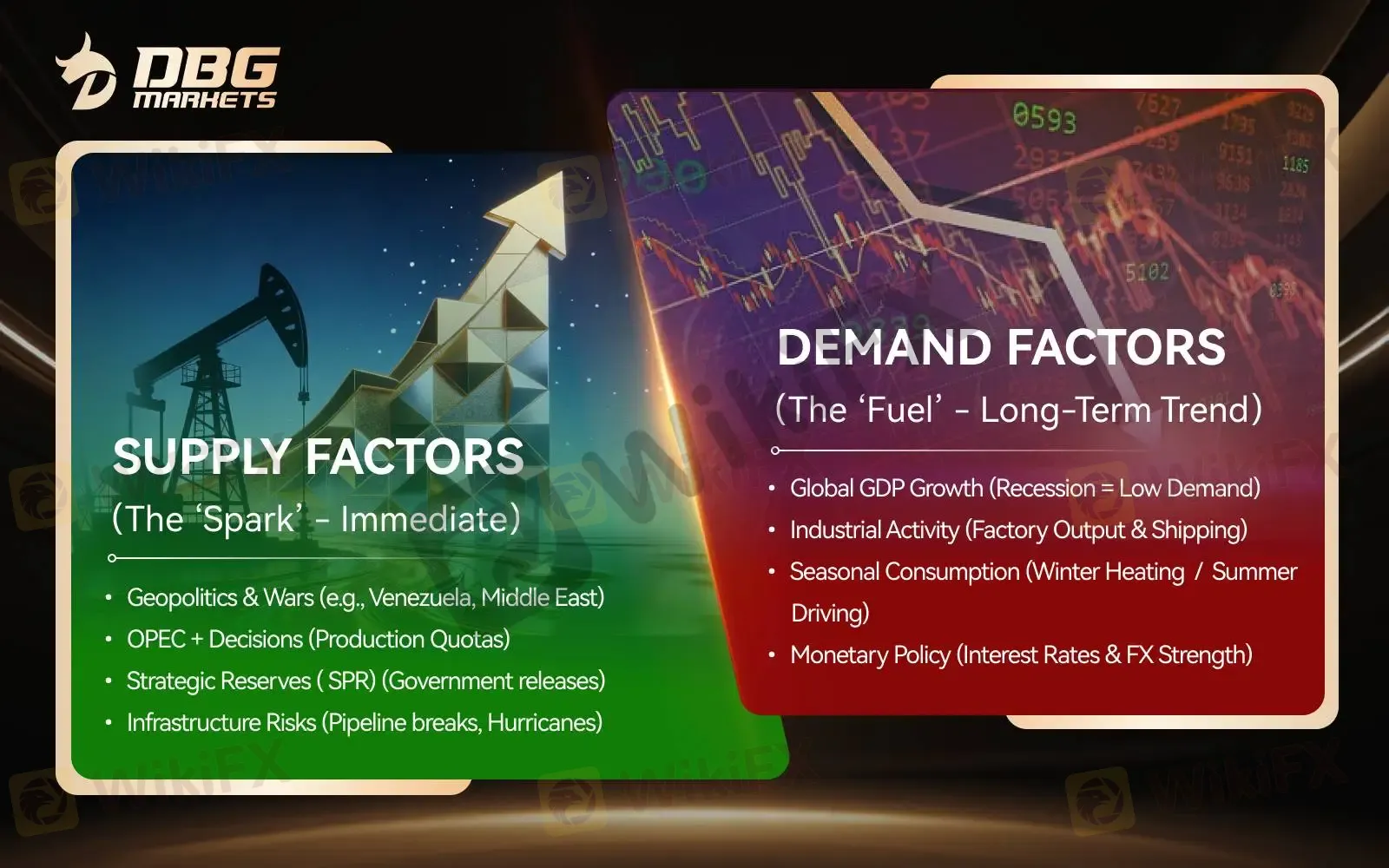
o The "Supply End": Driven by Geopolitics and Strategy. (Is the oil physically available? Who controls it?)
o The "Demand End": Driven by Economics. (Can the world afford to buy it? Is the economy growing?)
The Volatility, or the "whipsaw" effect, occurs when these two ends send conflicting signals at the same time.
2. The Supply End: Where Geopolitics Creates the "Fear Premium"
Currently, the volatility in January 2026 is being driven almost entirely by the Supply End. This side of the equation is sensitive to one major factor: Availability (and the fear of losing it).
Unlike the Demand End, which moves slowly with economic cycles, the Supply End is prone to sudden shocks. It is not just about current production; it is about the security of future barrels.
Case Study: How the Venezuela Crisis Hit the "Supply End" The recent market behavior is a textbook example of two Supply End factors colliding, creating a tug-of-war on price:
· The "Fear Factor" (Bullish / Upward Pressure): Political instability creates a "Geopolitical Risk Premium." Markets hate uncertainty. Traders fear that the chaos of regime change could damage infrastructure, incite labor strikes, or freeze exports, effectively tightening global supply. This speculation forces prices up.
· The "Inventory Factor" (Bearish / Downward Pressure): Conversely, the U.S. announcement to release 30–50 million barrels of Venezuelan storage acts as a massive liquidity injection. This implies an immediate surplus of physical oil hitting the market. This realization forces prices down.
The Result: The market could not immediately decide which factor was dominant—the potential for future disruption or the immediate flood of inventory—resulting in the aggressive whipsaw price action.
3. The Demand End: The Reality Check for "Real Moves"
While Supply End shocks (like the Venezuela news) cause immediate volatility and spikes, they rarely sustain a long-term trend on their own. For a "Real Move" (a sustained bull or bear market) to occur, the geopolitical spark must be supported by the Demand End.
Key Metrics to Watch on the Demand End:
1. Global Economic Health: Oil is the fuel of GDP. If the global economy is facing recessionary headwinds, factories produce less and logistics slow down. In such a scenario, even a supply shock in Venezuela won't sustain high prices because the fundamental buyer demand is absent.
2. Major Importer Consumption: Data from "Big Consumers" like China and the U.S. is critical. Are their strategic reserves full? Is their industrial output expanding or contracting?
3. Seasonal Cycles: Demand is cyclical. Are we entering the Northern Hemisphere winter (heating demand) or the summer driving season? Seasonal floors often dictate how far prices can fall.
4. Exogenous Shocks: Unexpected events—such as trade wars, pandemics (like 2020), or rapid shifts in green energy policy—can structurally alter long-term demand prospects, regardless of supply availability.
4. Supply and Demand: What Truly Moves the Oil Market
In summary, oil prices are always driven by supply and demand, but not all drivers carry equal weight at all times. Supply-side factors—especially geopolitical risks—often dominate short-term price movements and volatility; Demand-side confirmation is required for the market to establish a durable direction.
Supply shocks create the spark. Demand determines whether the fire spreads.
5. Conclusion
The Venezuela crisis ignited the Supply End, triggering sharp price whipsaws as the market struggled to balance geopolitical risk against potential increases in available supply.
However, for traders and investors seeking a sustained directional move, the focus must shift to the Demand End.
Disclaimer:
Le opinioni di questo articolo rappresentano solo le opinioni personali dell’autore e non costituiscono consulenza in materia di investimenti per questa piattaforma. La piattaforma non garantisce l’accuratezza, la completezza e la tempestività delle informazioni relative all’articolo, né è responsabile delle perdite causate dall’uso o dall’affidamento delle informazioni relative all’articolo.
WikiFX Trader
WikiFX Trader
Rate Calc
USD

CNY
Tasso di cambio attuale:0
inserisci l'importo
USD
A disposizione
CNY
Calcolare 