WikiFX Trending Topics Analyst Initiative
Share Your Expertise on What’s Moving the Market.
简体中文
繁體中文
English
Pусский
日本語
ภาษาไทย
Tiếng Việt
Bahasa Indonesia
Español
हिन्दी
Filippiiniläinen
Français
Deutsch
Português
Türkçe
한국어
العربية
Abstract:International oil prices have declined for two consecutive days, mainly due to the impact of U.S. tariff hikes, which have intensified market concerns over a global economic slowdown.

OPEC+ plans to increase production starting in April, further adding to market supply pressure and weighing on oil prices.
Recently, U.S. President Donald Trump announced tariff increases on products from Canada, Mexico, and several Asian countries, stating that trade pressure would not be eased. This policy has triggered market panic, prompting investors to reassess the global economic outlook and anticipate a decline in energy demand.
Additionally, investors are worried that the U.S. economy may be entering a “transition period” or even facing a recession, leading to heightened risk aversion and the sell-off of crude oil and other risk assets. Meanwhile, OPEC+s decision to increase production has created additional pressure on the supply side. Although Russia has hinted at possible adjustments, short-term supply growth still poses a challenge to oil prices.
In the short term, oil prices remain under downward pressure, but the market will closely monitor OPEC and IEA‘s monthly reports, U.S. inventory data, and the Federal Reserve’s monetary policy stance. If demand declines more than expected or crude oil inventories continue to rise, prices may fall further.
However, if the Federal Reserve adopts a more dovish stance, market sentiment may recover to some extent. Overall, given the economic slowdown, rising risk aversion, and OPEC+ production increases, the outlook for oil prices remains uncertain.
Disclaimer:
The views in this article only represent the author's personal views, and do not constitute investment advice on this platform. This platform does not guarantee the accuracy, completeness and timeliness of the information in the article, and will not be liable for any loss caused by the use of or reliance on the information in the article.

Share Your Expertise on What’s Moving the Market.

Strong retail participation in 2026 is driving forex and CFD trading volumes higher, as investors expand beyond equities into macro-sensitive markets.

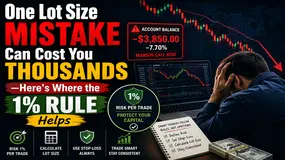
In a forex market where fundamental and technical factors impact the currency pair prices, volatility is expected. If the price volatility acts against the speculation made by traders, it can result in significant losses for them. This is where a stop-loss order comes to their rescue. It is one of the vital investment risk management tools that traders can use to limit potential downside as markets get volatile. Read on as we share its definition and several strategies you should consider to remain calm even as markets go crazy.

The forex market is a happening place with currency pairs getting traded almost non-stop for five days a week. Some currencies become stronger, some become weaker, and some remain neutral or rangebound. If you talk about the Indian National Rupee (INR), it has dipped sharply against major currencies globally over the past year. The USD/INR was valued at around 85-86 in Feb 2025. As we stand in Feb 2026, the value has dipped to over 90. The dip or rise, whatever the case may be, impacts our daily lives. It determines the price of an overseas holiday and imported goods, while influencing foreign investors’ perception of a country. The foreign exchange rates change constantly, sometimes multiple times a day, amid breaking news in the economic and political spheres globally. In this article, we have uncovered details on exchange rate fluctuations and key facts that every trader should know regarding these. Read on!