

Applicazione di richiesta di informazioni sulla regolamentazione dei broker globali
WikiFX
English
简体中文
繁體中文
English
Pусский
日本語
ภาษาไทย
Tiếng Việt
Bahasa Indonesia
Español
हिन्दी
Filippiiniläinen
Français
Deutsch
Português
Türkçe
한국어
العربية
Precious Metals: Rising Volatility Risks Come Into Focus
Sommario:CME Group has announced that, effective after the close on December 29, it will raise margin requirements across a broad range of metal futures, including gold, silver, palladium, platinum, and lithiu
CME Group has announced that, effective after the close on December 29, it will raise margin requirements across a broad range of metal futures, including gold, silver, palladium, platinum, and lithium. The adjustment applies to standard, mini, and micro contracts, effectively covering the core of its metals derivatives complex.
Market participants widely interpret this move as a clear signal that the exchange is becoming increasingly cautious about sharply elevated volatility in the precious metals market.
From a structural standpoint, higher margin requirements are designed to reduce leverage and raise the cost of participation, ensuring sufficient risk buffers during periods of extreme price swings. Historically, however, coordinated and concentrated margin hikes within a single asset class often indicate that the market has entered a phase where sentiment and leverage are reinforcing one another.
Silver provides a particularly illustrative example. As prices surged toward the $80 per ounce level, CMEs renewed action to curb leverage has revived memories of past episodes:
In 2011, CME raised silver margin requirements five times within nine days shortly before prices peaked.
During the 1980 Hunt Brothers episode, margin increases similarly marked the beginning of aggressive leverage compression.
History suggests that exchange-level risk controls typically arrive after price dynamics have already become dislocated, rather than before volatility emerges.
What distinguishes the current silver rally from past episodes is that it is not purely speculative. Silver plays an increasingly irreplaceable industrial role in sectors such as solar energy, electric vehicles, and data centers. Declining inventories and structural supply tightness continue to pressure the physical market, helping explain why prices remain resilient even at elevated levels.
That said, the pace of the rally has raised concerns from the industrial side. Elon Musk, founder of Tesla, has publicly warned that a surge in silver prices is “not good for industrial development,” highlighting the risk that unchecked raw material inflation could ultimately weigh on downstream demand and capital investment.
Overall, CMEs margin hike does not necessarily signal the end of the trend, but it does suggest that the leverage-driven phase of the rally is cooling. Short-term speculative capital now faces higher costs, volatility may increase further, and price behavior is likely to depend more heavily on real money flows and medium- to long-term allocation logic.
For investors, the key at this stage is not forecasting direction, but rather position sizing and risk management. When exchanges begin to systematically tighten leverage, markets often enter a phase that becomes far less forgiving for participants.
Gold Technical Analysis
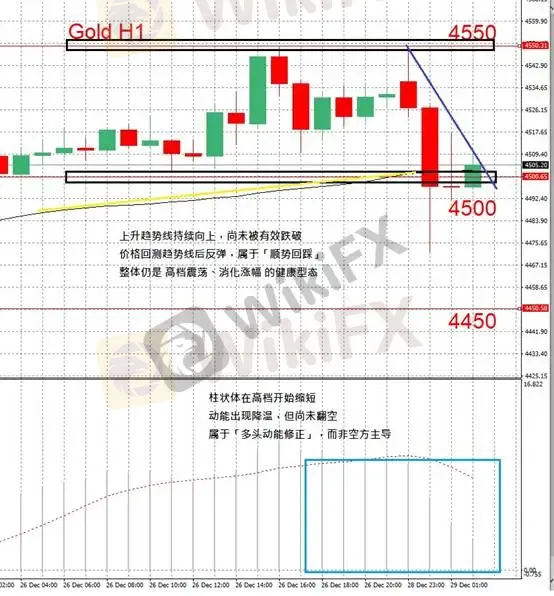
Following the Federal Reserve‘s official entry into a rate-cutting cycle, gold’s medium-term trend remains bullish. However, short-term price action at elevated levels has begun to show clear signs of consolidation. On the latest H1 chart, prices failed to hold above the $4,550 resistance zone and pulled back sharply, suggesting that momentum-driven buying is becoming more cautious.
Price Structure
Price briefly pushed toward $4,550, where strong resistance emerged
A large bearish candle followed, triggering a swift pullback toward $4,500
The decline did not break the rising trendline, indicating buying interest at lower levels
Moving Averages and Trend
The ascending trendline remains intact and has not been decisively broken
Price rebounded after testing the trendline, consistent with a trend-following pullback
Overall structure reflects high-level consolidation and digestion of prior gains, a technically healthy pattern
MACD Analysis
Histogram bars have begun to contract at elevated levels
Momentum is cooling but has not turned bearish
This reflects a bullish momentum correction, rather than a shift to downside dominance
Under the broader backdrop of Fed rate cuts, gold remains structurally bullish, but the market has entered a short-term consolidation phase at high levels.
Resistance: $4,550/oz
Support: $4,500 / $4,450 per ounce
Risk Disclaimer:
The views, analyses, research, prices, or other information contained herein are provided for general market commentary only and do not represent the position of this platform. All readers assume full responsibility for their own risk. Please trade with caution.
Disclaimer:
Le opinioni di questo articolo rappresentano solo le opinioni personali dell’autore e non costituiscono consulenza in materia di investimenti per questa piattaforma. La piattaforma non garantisce l’accuratezza, la completezza e la tempestività delle informazioni relative all’articolo, né è responsabile delle perdite causate dall’uso o dall’affidamento delle informazioni relative all’articolo.
WikiFX Trader
Rate Calc
USD

CNY
Tasso di cambio attuale:0
inserisci l'importo
USD
A disposizione
CNY
Calcolare