

Applicazione di richiesta di informazioni sulla regolamentazione dei broker globali
WikiFX
English
简体中文
繁體中文
English
Pусский
日本語
ภาษาไทย
Tiếng Việt
Bahasa Indonesia
Español
हिन्दी
Filippiiniläinen
Français
Deutsch
Português
Türkçe
한국어
العربية
Gold Rallies Sharply After Christmas
Sommario:(Figure 1 | Source: M²)Following the Christmas holiday, golds upside momentum has clearly re-accelerated, with prices once again setting a new all-time high, briefly reaching USD 4,530 per ounce. Whil
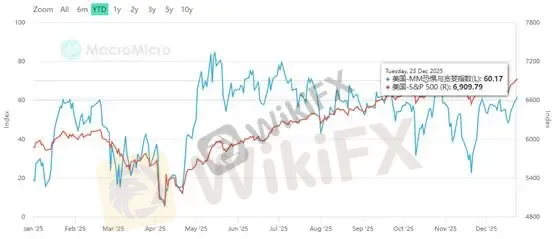
(Figure 1 | Source: M²)
Following the Christmas holiday, golds upside momentum has clearly re-accelerated, with prices once again setting a new all-time high, briefly reaching USD 4,530 per ounce. While the broader market structure remains firmly bullish, sentiment indicators suggest that the rally is not yet overheated.
As shown in Figure 1, the Fear & Greed Index is currently hovering around 60, having moved above neutral and into mildly greedy territory. This indicates that risk appetite is improving compared with recent months, but has not yet reached levels associated with extreme optimism.
Looking back at price behavior this year, periods when the Greed Index approached the 70–80 range often coincided with heightened volatility or corrective pullbacks. In contrast, the current reading in the low-60s appears more consistent with a trend-continuation phase. This suggests that although risk assets are generally trading at elevated levels, capital remains relatively cautious. Amid ongoing shifts between risk-on and defensive positioning, part of the flow continues to favor gold, helping sustain its upward momentum.
On the macro front, the United States recently reported Q3 annualized GDP growth of 4.3%, exceeding market expectations, driven primarily by resilient consumer spending and improved exports. However, core PCE inflation rebounded to 2.9%, reinforcing expectations that the Federal Reserve will proceed cautiously with rate cuts. Combined with still-subdued consumer confidence, the U.S. Dollar Index briefly fell below the 98.00 level, providing additional support for gold prices.
Moreover, last weeks data showed declines in both initial jobless claims and core CPI, signaling improvements in employment conditions and inflation dynamics. These developments strengthened market confidence in a soft landing for the U.S. economy. While such data is typically negative for gold, the downside pressure has been limited, highlighting persistent safe-haven demand. As a result, gold has remained resilient, holding firmly above the USD 4,400 per ounce threshold despite ongoing tug-of-war between bullish and bearish forces.
Against a backdrop of improving growth data but lingering inflation uncertainty, markets have not fully shifted into a risk-on stance. Instead, the environment continues to favor gold. As long as the U.S. dollar remains under pressure and interest rates trend lower, a structural reversal in gold appears unlikely. Overall, the bias for gold remains constructive, with further consolidation at elevated levels or renewed record highs still firmly on the table.
Gold Technical Analysis

From a 1-hour chart perspective, gold confirmed a bullish Change of Character (CHOCH) after decisively breaking above the previous resistance at USD 4,501 per ounce, marking a structural shift to the upside. This breakout validated bullish control and extended the prevailing uptrend.
The primary defensive level is currently located at USD 4,430, while the secondary long order zone lies between USD 4,448–4,478. Together, these levels form a rising trend structure. Price action remains consistently above the 20-period Exponential Moving Average (20 EMA), indicating that bullish momentum remains intact.
Discount zone: USD 4,450–4,425 per ounce.
During the early session, prices briefly tested the upper boundary of the discount zone, signaling continued bullish momentum and the potential for a new upward leg. While upside inertia remains intact, a cautious mindset is still warranted at elevated levels.
Should upside momentum weaken and prices break decisively below USD 4,450, it would signal deterioration in bullish defense and significantly increase downside risk.
Traders are advised to remain patient and avoid emotional decision-making until entry conditions are clearly met. Patience, discipline, and consistency are essential for long-term trading success.
Risk management guidelines recommend limiting stop-loss exposure to 2%–5% per trade, with total intraday losses capped below 10%. For breakout trades, the use of trailing stops is recommended to protect profits.
Risk Disclaimer
The views, analysis, research, prices, and other information provided herein are for general market commentary only and do not represent the position of this platform. All readers assume full responsibility for their own risks. Please trade with caution.
Disclaimer:
Le opinioni di questo articolo rappresentano solo le opinioni personali dell’autore e non costituiscono consulenza in materia di investimenti per questa piattaforma. La piattaforma non garantisce l’accuratezza, la completezza e la tempestività delle informazioni relative all’articolo, né è responsabile delle perdite causate dall’uso o dall’affidamento delle informazioni relative all’articolo.
WikiFX Trader
Exness
Sotto supervisione
VT Markets
Sotto supervisione
STARTRADER
Sotto supervisione
IC Markets Global
Sotto supervisione
HFM
Sotto supervisione
EBC
Sotto supervisione
Exness
Sotto supervisione
VT Markets
Sotto supervisione
STARTRADER
Sotto supervisione
IC Markets Global
Sotto supervisione
HFM
Sotto supervisione
EBC
Sotto supervisione
WikiFX Trader
Exness
Sotto supervisione
VT Markets
Sotto supervisione
STARTRADER
Sotto supervisione
IC Markets Global
Sotto supervisione
HFM
Sotto supervisione
EBC
Sotto supervisione
Exness
Sotto supervisione
VT Markets
Sotto supervisione
STARTRADER
Sotto supervisione
IC Markets Global
Sotto supervisione
HFM
Sotto supervisione
EBC
Sotto supervisione
Rate Calc
USD

CNY
Tasso di cambio attuale: 0
inserisci l'importo
USD
A disposizione
CNY
Calcolare