

Applicazione di richiesta di informazioni sulla regolamentazione dei broker globali
WikiFX
English
简体中文
繁體中文
English
Pусский
日本語
ภาษาไทย
Tiếng Việt
Bahasa Indonesia
Español
हिन्दी
Filippiiniläinen
Français
Deutsch
Português
Türkçe
한국어
العربية
🇺🇸 U.S. Policy Back in the Spotlight
Sommario:U.S. fiscal and monetary policies have once again returned to the center of market attention. Treasury Secretary Bessent recently offered fresh remarks on the Federal Reserve‘s authority, the governan
U.S. fiscal and monetary policies have once again returned to the center of market attention. Treasury Secretary Bessent recently offered fresh remarks on the Federal Reserve‘s authority, the governance structure of regional Fed banks, and the administration’s tariff agenda. At the same time, the White House‘s decision to waive the interview process has made Kevin Hassett’s path to becoming the next Fed Chair increasingly clear. Meanwhile, the latest moves in the U.S. bond market, labor data, and services-sector indicators reveal deepening structural divergences within the economy.
Secretary Bessent said Wednesday that the Fed Chairs direct control over interest rates is more limited than commonly perceived, noting that markets often place excessive focus on the Chair while overlooking the collective decision-making role of the FOMC. He added that the administration plans to introduce a new rule requiring candidates for regional Fed presidencies to have lived in their district for at least three years—aiming to strengthen local representation and improve policy relevance.
Bessent also voiced concerns about private credit, warning that the asset class tends to be highly pro-cyclical during economic downturns and could amplify systemic stress. On tariffs, he emphasized that regardless of how ongoing tariff-related cases proceed at the Supreme Court, the Trump administration still retains broad executive authority to push forward its tariff agenda—reinforcing the White Houses strong leverage over trade policy.
🇺🇸 Labor Market Polarization Intensifies
The newly released November ADP employment report came in sharply below expectations, showing a decline of 32,000 jobs—the steepest drop since March 2023. Small firms experienced the heaviest losses: companies with fewer than 50 employees shed a total of 120,000 positions, with firms employing 20–49 workers cutting 74,000 jobs alone.
In stark contrast, large corporations added 90,000 jobs, underscoring a widening bifurcation in the labor market. This structural divergence highlights how tightening credit, rising costs, and operational pressure disproportionately impact smaller businesses—suggesting that overall labor-market resilience may be overstated.
🇺🇸 Services Activity Strengthens, but with Uneven Momentum
The U.S. ISM Services PMI climbed to 52.6 in November, marking the fastest expansion in nine months. Stronger business activity and longer supplier delivery times contributed to the improvement. Notably, the prices-paid index fell to a seven-month low, indicating easing cost pressures across the services sector. The employment sub-index also rose to a six-month high of 48.9, suggesting a slower pace of contraction and marginal improvement in labor conditions.
Overall, the data signal continued resilience in services, but also highlight uneven dynamics across costs, orders, and hiring.
🇺🇸 Economic Divergence Deepens
Together, the latest labor and services-sector data reveal clear fragmentation within the U.S. economy:
• Small businesses are increasingly strained,
• Large corporations continue to expand,
• Services costs are easing but momentum remains inconsistent.
As political, policy, and macroeconomic forces converge, the U.S. market is likely to face elevated volatility and greater directional uncertainty in the coming months.
Gold Technical Analysis (H1 Chart)
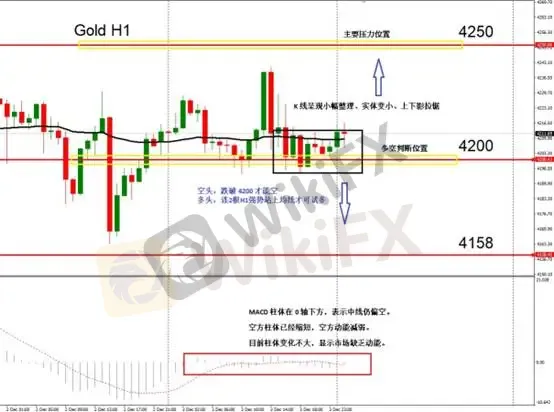
In the latest H1 chart, gold remains stuck in a broad consolidation between $4,250, $4,200, and $4,158, with no clear breakout. Prices are holding above $4,200, but with limited momentum. Although gold is trading above the threshold, recent candlesticks show narrowing bodies and back-and-forth wicks—indicating a weak, directionless market.
Holding above $4,200 signals a pause in bearish pressure, but does not indicate a bullish reversal.
Moving Averages
The black moving average is flattening and turning slightly lower, reflecting a “sideways-to-soft” market tone.
Price action continues to oscillate around the moving average with no clear advantage for either bulls or bears.
A bullish bias requires multiple consecutive H1 closes above the moving average.
A bearish continuation requires a decisive break back below $4,200.
MACD Analysis
MACD histogram remains below the zero line, indicating a medium-term bearish bias.
Negative momentum bars are shrinking, showing weakening bearish pressure.
Histogram movement has been muted, signaling a lack of market momentum.
Trade Setup
Bearish:
Sell only if price breaks decisively below $4,200.
Bullish:
Long positions may be considered only if two consecutive strong H1 candles close above the moving average.
Key Levels
Resistance: $4,250/oz
Support: $4,200 and $4,158/oz
Risk Disclaimer
The views, analysis, research, prices, and other information provided above constitute general market commentary only and do not represent the views of this platform. All readers should exercise caution and take full responsibility for their own investment decisions.
Disclaimer:
Le opinioni di questo articolo rappresentano solo le opinioni personali dell’autore e non costituiscono consulenza in materia di investimenti per questa piattaforma. La piattaforma non garantisce l’accuratezza, la completezza e la tempestività delle informazioni relative all’articolo, né è responsabile delle perdite causate dall’uso o dall’affidamento delle informazioni relative all’articolo.
WikiFX Trader
fpmarkets
Sotto supervisione
HFM
Sotto supervisione
STARTRADER
Sotto supervisione
octa
Sotto supervisione
FXTM
Sotto supervisione
Ultima
Sotto supervisione
fpmarkets
Sotto supervisione
HFM
Sotto supervisione
STARTRADER
Sotto supervisione
octa
Sotto supervisione
FXTM
Sotto supervisione
Ultima
Sotto supervisione
WikiFX Trader
fpmarkets
Sotto supervisione
HFM
Sotto supervisione
STARTRADER
Sotto supervisione
octa
Sotto supervisione
FXTM
Sotto supervisione
Ultima
Sotto supervisione
fpmarkets
Sotto supervisione
HFM
Sotto supervisione
STARTRADER
Sotto supervisione
octa
Sotto supervisione
FXTM
Sotto supervisione
Ultima
Sotto supervisione
Rate Calc
USD

CNY
Tasso di cambio attuale: 0
inserisci l'importo
USD
A disposizione
CNY
Calcolare