

Global Broker Regulation Inquiry App
WikiFX
English
简体中文
繁體中文
English
Pусский
日本語
ภาษาไทย
Tiếng Việt
Bahasa Indonesia
Español
हिन्दी
Filippiiniläinen
Français
Deutsch
Português
Türkçe
한국어
العربية
FXTRADING Financial Focus (Asia-Pacific 02/26)US State of the Union reinforces recovery narrative
Abstract:With the midterm elections approaching, the political atmosphere in the United States is clearly heating up. The latest polls show that voters remain pessimistic about current economic conditions, wit
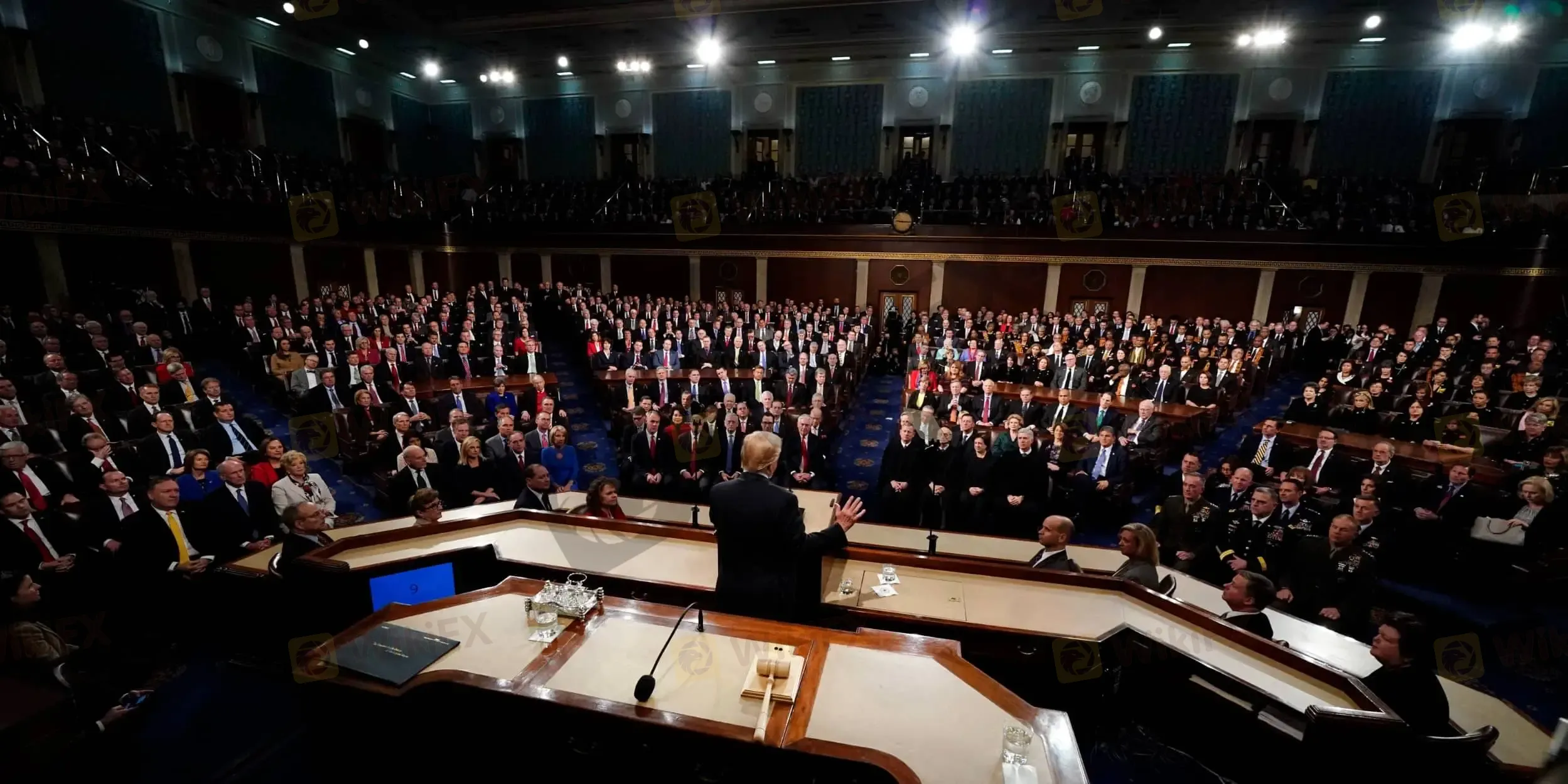
With the midterm elections approaching, the political atmosphere in the United States is clearly heating up. The latest polls show that voters remain pessimistic about current economic conditions, with high prices and rising living costs emerging as the primary concerns. Support among independent voters for the president continues to decline, and overall approval ratings remain in a relatively weak range. Against this backdrop, economic performance and policy disputes are increasingly becoming the central battleground between the two parties.
At this point in time, Trump delivered his State of the Union address, sending a strong signal of confidence. He described the effects of the past years policies as a clear improvement, emphasizing that economic momentum is recovering. Indicators such as income growth, easing inflation, and strengthening national power were repeatedly highlighted. Judging from the tone and pacing of the speech, it appeared more like a mobilization effort aimed at boosting confidence, with the goal of stabilizing public expectations and creating room for future policy initiatives by reinforcing the recovery narrative.
However, the real environment is not as uniformly optimistic as presented. Although some economic indicators have improved, prices for essential goods such as food and energy remain elevated, and households have not experienced a meaningful improvement in their perceived purchasing power. The labor market is also showing signs of structural cooling, with the quality and stability of job creation last year falling short of previous cycles. The gap between marginal data improvement and public sentiment remains evident, which is a key reason why market confidence has stayed cautious.
Trade policy remains one of the most controversial areas at present. Previous global tariff measures were struck down by the Supreme Court, placing institutional constraints on the administrations trade strategy. However, official statements suggest that the White House does not intend to scale back its policy direction. Instead, it plans to pursue import restrictions through alternative legal channels and expects tariffs to become an important source of fiscal revenue. The concern is that tariffs are ultimately passed through to businesses and consumers via higher prices, reinforcing market fears of a second round of inflationary pressure.
Foreign policy and security issues are also adding to uncertainty. Strong rhetoric regarding the Middle East and discussions of potential actions have brought external risks back into the markets focus. At the same time, confrontations within Congress over immigration, budgeting, and law enforcement continue to intensify. The increasingly heated public clashes between the two parties reflect growing difficulties in advancing policy, and heightened political friction suggests that future policy implementation may become more inconsistent and subject to reversal.
On the policy front, Trump also introduced several new domestic initiatives, including matching savings contributions for workers who cannot participate in employer-sponsored retirement plans and promoting restrictions on individual stock trading by members of Congress. However, the funding sources and implementation pathways for these proposals remain unclear. Markets are more concerned about overall fiscal constraints and long-term sustainability rather than short-term policy signaling alone.
Overall, this State of the Union address appears to represent a reshaping of both political and economic narratives. While the administration seeks to stabilize confidence by emphasizing recovery and strength, voters and markets continue to reassess risks through the lenses of inflation, employment conditions, and policy uncertainty. As the midterm elections approach, fiscal, trade, and foreign policies may become increasingly influenced by political bargaining. From FXTRADING‘s perspective, rising policy uncertainty in the United States is becoming an important driver of exchange rates and capital flows. If tariffs and geopolitical risks intensify, safe-haven demand could support the US dollar in the short term. However, if inflation pressures re-emerge due to higher trade costs, the Federal Reserve’s policy path may face more complex trade-offs, and dollar volatility is expected to increase, with global markets likely to experience repeated fluctuations in the near term.
Disclaimer:
The views in this article only represent the author's personal views, and do not constitute investment advice on this platform. This platform does not guarantee the accuracy, completeness and timeliness of the information in the article, and will not be liable for any loss caused by the use of or reliance on the information in the article.
WikiFX Broker
Latest News
CONSOB Blocks Five More Unauthorised Investment Websites as Online Scam Tactics Evolve
 WikiFX
Retail Trading Momentum Extends into 2026, Reshaping FX and CFD Activity
WikiFXFX SmartBull Regulation: Understanding Their Licenses and Company Information
WikiFXStock Trading Guru Scams Contractor Out of RM1.2 Million with ‘Guaranteed Profits’
WikiFXNeptune Securities Exposure: Real Forex Scam Warnings
WikiFXAdmiral Markets Review: Regulation, Licences and WikiScore Analysis
WikiFX1,789 Victims, Nearly $300 Million Lost: Gold High-Return Scam Exposed
WikiFXUPFOREX Regulatory Status: A 2026 Deep Dive into Its Licenses and Risks
WikiFXHKEX Profit Surge Signals Massive Chinese Capital Inflow and Asian Market Resilience
WikiFXThe micro-documentary "Let Trust Be Seen" is officially launched today!
WikiFXCurrency Calculator
USD

CNY
Current Rate:0
Amount
USD
Available
CNY
Calculate 