Abstract:You are here for a direct answer: Is EXTREDE legit or a platform to avoid? We will respect your time and provide the evidence-based conclusion immediately. The details that follow will build the case, but the verdict is clear from the start. Read on to find the answer to this most sought-after question.
The Verdict Upfront
You are here for a direct answer: Is EXTREDE legit or a platform to avoid? We will respect your time and provide the evidence-based conclusion immediately. The details that follow will build the case, but the verdict is clear from the start.
The Short Answer
Based on verifiable, third-party data, EXTREDE operates without any valid regulation from a major financial authority. Global broker inquiry platform, WikiFX, which gathers regulatory data and user reviews, assigns EXTREDE a score of 1.10 out of 10.00. This score, combined with a “Low score, please stay away!” warning, places this entity firmly in the highest-risk category for any trader.
What This Means
Trading with an unregulated broker is extremely risky. It means your deposited funds are not protected by any client fund separation rules. In the event of a dispute, withdrawal issue, or outright fraud, there is no regulatory body to appeal to and no legal help available through industry compensation schemes. You are, in effect, operating without a safety net.
> Warning: High Risk Identified
> Our investigation concludes that EXTREDE shows multiple critical red flags, the most severe being a complete lack of verifiable financial regulation. We strongly advise against depositing funds with this entity.
Claims Versus Facts
A broker's website is its primary marketing tool. It is designed to build trust and encourage deposits. However, these claims must stand up to independent reviews. We will now examine the story presented on the EXTREDE website by comparing it directly with verifiable data. The inconsistencies are not minor; they are fundamental contradictions that question the very foundation of the broker's identity.
These differences are alarming. A broker's history, regulatory status, and operational transparency are the pillars of its legitimacy. When all of these pillars crumble under basic verification, it signals a significant danger to potential clients. You can review the complete data profile and see these red flags compiled in one place on its official WikiFX page.
Understanding the Red Flags
The table above presents the data. Now, let's interpret it. Understanding *why* these red flags are crucial for developing the skills to protect yourself from similar operations in the future. These are not small administrative errors; they are classic indicators of a potentially fraudulent setup.
The Absence of Regulation
This is the most critical red flag and a non-negotiable deal-breaker. Reputable brokers are authorized and regulated by top-tier financial authorities. These include bodies like the Financial Conduct Authority (FCA) in the UK, the Cyprus Securities and Exchange Commission (CySEC), or the Australian Securities and Investments Commission (ASIC).
This oversight is not just a rubber stamp. It requires that brokers:
· Separate client funds from company operational funds, protecting your capital if the broker becomes insolvent.
· Follow strict marketing and operational conduct rules.
· Provide access to a financial services compensation scheme. For instance, clients of FCA-regulated brokers are often protected by the Financial Services Compensation Scheme (FSCS). If a broker fails, the FSCS can provide compensation.
EXTREDE's claim of regulation is directly contradicted by verification checks. Operating without a license means it is not bound by any of these protections. Your capital is entirely at its mercy.
Misleading Corporate Data
The gap between a claimed “12 years of experience” and a verified operational history of “Within 1 year” is a deliberate attempt to create false trustworthiness. New, high-risk operations often invent a long history to appear stable and reliable. As of 2026, a company founded in 2012 would have 14 years of history, but data shows this entity is a recent creation.
Furthermore, WikiFX flags EXTREDE with a “Suspicious Scope of Business.” This often indicates that the company's registered activities do not align with the high-risk financial services (like leveraged CFD trading) it offers to the public. The mismatch between a claimed London headquarters and a server based in India also raises serious questions about the company's true location and operational base.
Predatory Account Conditions
Legitimate brokers aim to provide accessible trading conditions. EXTREDE's account structure appears designed to extract maximum capital from unsuspecting clients. The minimum deposit for its “VIP FX” account is an excessive $20,000. This is wildly out of line with industry standards, where top-tier brokers often allow entry for a few hundred dollars or less.
Combining this high deposit requirement with high leverage (up to 400:1) creates a toxic environment for traders. High leverage amplifies both gains and losses, and when applied to a large, pressured deposit in an unregulated ecosystem, it dramatically increases the risk of a total loss. This structure is more indicative of a system designed for client loss than for client success.
A pattern of such red flags is a clear indicator of high risk. For a live, detailed view of EXTREDE's current regulatory status and any new user-submitted complaints, always check its entry on WikiFX.
Your Due Diligence Checklist
The investigation into EXTREDE serves as a powerful case study. You can use this same process to protect yourself from any potential brokerage scam. Before depositing funds, follow this simple, four-step due diligence checklist. It will become your most effective shield against deception.
Step 1: Use Verification Tools
Your first step should never be the broker's website. A slick marketing page can be persuasive and misleading. Instead, start with a neutral, data-driven platform. An experienced analyst's process begins with an aggregator, such as WikiFX, which compiles essential data in one place. Search for the broker's name and check its regulatory status, operational history, and overall score before getting influenced by its marketing claims.
Step 2: Verify Licenses
If a broker claims to be regulated, it must provide a license or registration number. Do not take its word. Copy this number and visit the official public register of the regulatory body it claims (e.g., the FCA's Financial Services Register). If you cannot find the broker or if the details do not match perfectly, consider the regulatory claim to be false. A claim of regulation without a verifiable number is worthless.
Step 3: Examine The Website
Once you have verified the core data, you can analyze the broker's website for inconsistencies, just as we did with EXTREDE.
· Does the claimed founding date or “years of experience” align with the website's domain registration date (which can be checked with a WHOIS lookup tool)?
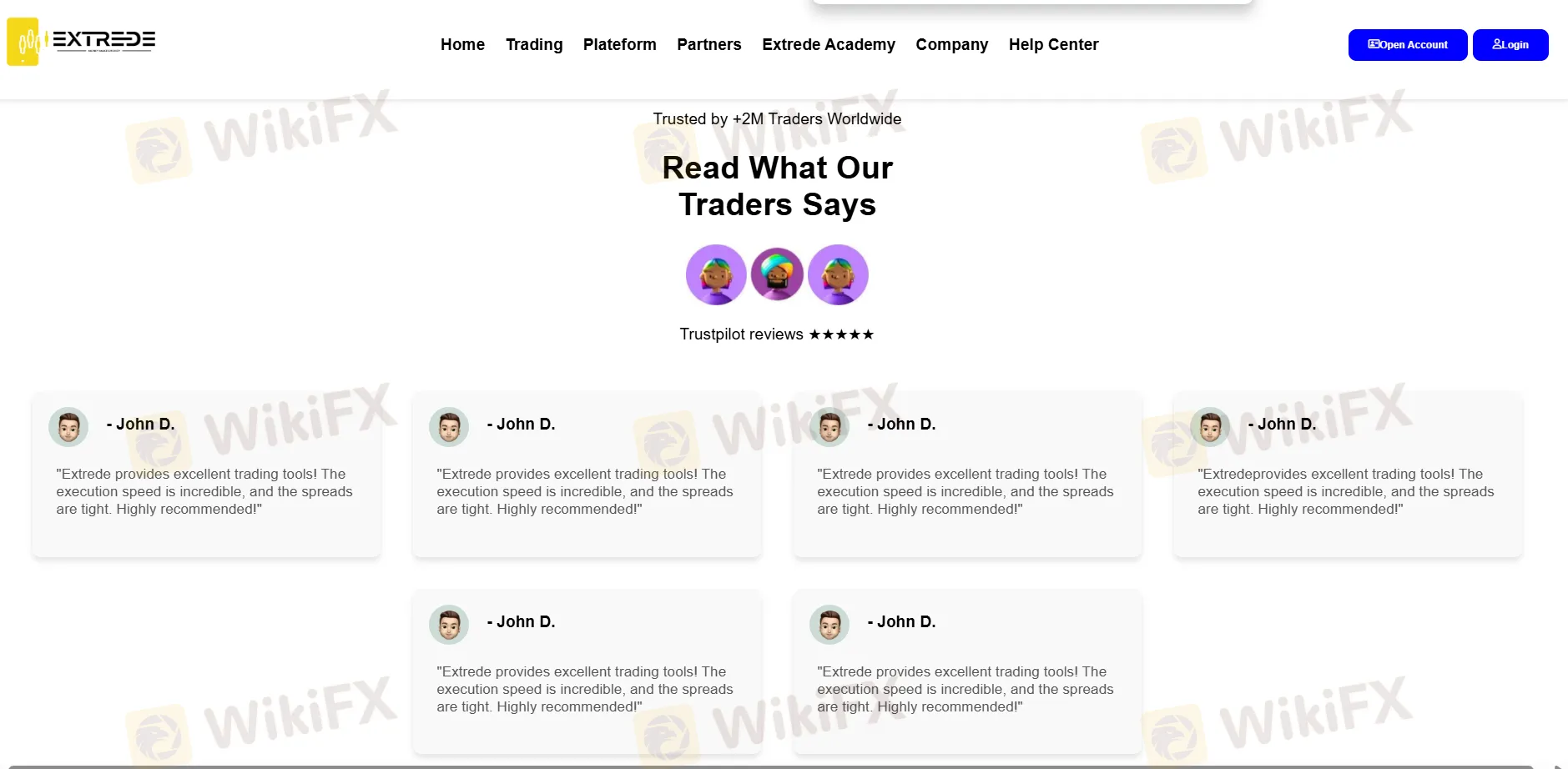
· Are the client testimonials generic stock photos with vague praise, or are they specific and verifiable? “John D.” saying the platform is great is not a credible testimonial. Additionally, this trader is the only one found in the testimonial section of the brokers website.
· Is the physical address a real office building, or is it a virtual office or mail-forwarding service? A quick search on Google Maps can often reveal this.
Step 4: Assess Trading Conditions
Finally, look at the trading conditions with a critical eye. Be wary of any broker that:
· Pressures you into making a large initial deposit.
· Promises guaranteed or unrealistically high returns.
· Offers extreme bonuses that seem too good to be true (these often come with impossible withdrawal conditions).
· Uses aggressive, high-pressure sales tactics via phone or email.
Legitimate brokers provide educational resources and risk warnings; predatory entities focus on pressure and promises.
Conclusion: The Final Verdict
The initial question was simple: Is EXTREDE legit? After a thorough review of the available evidence, the conclusion is equally straightforward.
The Clear Answer
EXTREDE shows an overwhelming number of red flags that are characteristic of high-risk, untrustworthy online operations. The complete lack of valid regulation, the direct contradictions between its marketing claims and verifiable facts, an abysmal trust score of 1.10, and predatory account conditions all point to an entity that traders should avoid at all costs. While we refrain from using definitive labels, the evidence strongly suggests that engaging with EXTREDE poses a severe risk to your capital and could be considered an EXTREDE scam.
Your Safest Next Step
The world of online trading is filled with both genuine opportunities and sophisticated traps. The single most powerful skill you can develop is the ability to investigate brokers through careful, independent verification. Do not rely on a broker's self-proclaimed status. Trust data.
Protect your capital. Before engaging with *any* broker, new or old, perform your due diligence. We strongly recommend using a platform, such as WikiFX, to check a broker's regulatory status, operational history, and user feedback before opening an account. Your financial safety depends on it.