

Global Broker Regulation Inquiry App
WikiFX
English
简体中文
繁體中文
English
Pусский
日本語
ภาษาไทย
Tiếng Việt
Bahasa Indonesia
Español
हिन्दी
Filippiiniläinen
Français
Deutsch
Português
Türkçe
한국어
العربية
U.S. Beige Book Shows a Soft but Resilient Economy
Abstract:(Figure 1. Source: Google)The U.S. economy is gradually stabilizing after emerging from the disruption caused by the recent government shutdown. With the delayed release of key inflation data now back
(Figure 1. Source: Google)
The U.S. economy is gradually stabilizing after emerging from the disruption caused by the recent government shutdown. With the delayed release of key inflation data now back on track, the latest Beige Book offers timely insights into current economic conditions. Overall, the report suggests that the U.S. economy remains resilient, though far from robust—best described as stable with a soft undertone.
Economic Activity: Stable but Losing Momentum
Across the 12 Federal Reserve districts, economic activity was little changed—neither showing meaningful expansion nor significant contraction. Only a few districts reported modest growth, while most noted stable conditions with early signs of softening. The economy appears to be “gliding forward with the brakes lightly pressed”—slowing, but not yet stalling.
Labor Market: Demand Is Cooling
The Beige Book highlights weaker labor demand, with roughly half of the districts reporting hiring freezes, reduced recruitment plans, or firms choosing only to replace departing employees. Though widespread layoffs have not emerged, labor market momentum is clearly cooling.
For the Federal Reserve, this is a double-edged sword. Softer wage pressures help ease inflation, but continued deterioration in employment could weaken consumer spending and overall economic momentum.
Consumer Spending: Noticeable Slowdown
Non-essential consumer spending has slowed significantly. More households are becoming cautious with discretionary purchases, and the temporary suspension of certain federal benefits during the shutdown hit lower-income groups hardest. Since nearly 70% of the U.S. economy is consumption-driven, weakening consumer demand naturally drags on overall growth.
Prices & Wages: Moderating but Still Rising
Both prices and wages are still rising, but at a moderate pace. While inflation remains above target, it is no longer accelerating. Some businesses continue passing higher costs to consumers, whereas others are opting to hold prices steady to avoid losing demand. Inflationary pressure remains present but no longer as stubborn as before.
Market Implications
The Beige Book signals that the Federal Reserve has room to cut rates, though policymakers are likely to proceed cautiously. Markets are currently pricing in over an 86% chance of a December rate cut. Rising rate-cut expectations typically weaken the U.S. dollar, putting it on track to trade within a range-bound but downward-biased structure in the near term. This environment tends to be supportive of gold as lower U.S. yields and a softer dollar enhance its appeal.
Gold Technical Analysis
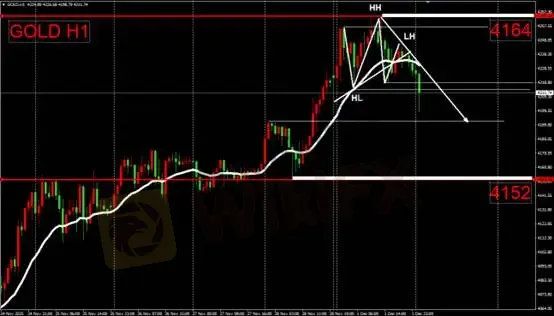
1-Hour Chart: 20-EMA Breakdown Confirms Correction
Early-session trading saw gold fall below the 20-EMA, confirming renewed bearish momentum and a continuation of the corrective phase.
Until a strong reversal signal appears, traders should observe rather than attempt premature entry.
Only after price reclaims the 20-EMA can a rebound be expected. Persistent rejection below the EMA would indicate weakening bullish defense.
Discount Zone: $4,150–$4,195/oz
Todays Strategy: Bullish bias. Look for long setups above $4,245 and above the 20-EMA.
Comment: The discount zone provides attractive risk-reward potential, but a confirmed bottoming structure is required before entry. The key lies in whether price can reclaim the 20-EMA—this will determine short-term directional strength.
Risk Disclaimer
This analysis, commentary, and any associated price levels are for general market information only and do not constitute investment advice. All trading involves risk. Readers should evaluate their own risk tolerance and exercise caution.
Disclaimer:
The views in this article only represent the author's personal views, and do not constitute investment advice on this platform. This platform does not guarantee the accuracy, completeness and timeliness of the information in the article, and will not be liable for any loss caused by the use of or reliance on the information in the article.
WikiFX Broker
Latest News
Absolute Markets 2025: Is It Scam or Safe? Suitable for Traders in Pakistan?
 WikiFX
Offshore Forex Brokers Ramp Up Expansion in Vietnam as Authorities Crack Down on Scams
WikiFX'Worse Than COVID': Weak US Manufacturing Surveys Signal Stagflation In November
WikiFXScam Alert: 8,500 People Duped with Fake 8% Monthly Return Promises from Forex and Stock Investments
WikiFXUK snack brand Graze to be sold to Jamie Laing\s Candy Kittens
WikiFXFTMO Completes Acquisition of Global CFDs Broker OANDA, Marking a Major Milestone
WikiFXHEADWAY: The Fast Track to Financial Dead-Ends?
WikiFXNovember private payrolls unexpectedly fell by 32,000, led by steep small business job cuts, ADP reports
WikiFXPlus500 Allegations Exposed in Real Trader Cases
WikiFXUS Industrial Production Sees Biggest Annual Gain In 3 Years Despite Slowing Capacity Utilization
WikiFXCurrency Calculator
USD

CNY
Current Rate: 0
Amount
USD
Available
CNY
Calculate