

Globale Broker-Regulierungsanfrage-App
WikiFX
Deutsch
简体中文
繁體中文
English
Pусский
日本語
ภาษาไทย
Tiếng Việt
Bahasa Indonesia
Español
हिन्दी
Filippiiniläinen
Français
Deutsch
Português
Türkçe
한국어
العربية
U.S. Government Shutdown Risk Resurfaces as Market Volatility Intensifies
Zusammenfassung:[Figure 1: Illustration of the U.S. Government]A series of shootings in Minneapolis has triggered a political crisis, as Senate Democrats unanimously rejected a spending bill that includes funding for

[Figure 1: Illustration of the U.S. Government]
A series of shootings in Minneapolis has triggered a political crisis, as Senate Democrats unanimously rejected a spending bill that includes funding for the Department of Homeland Security (DHS). The probability of a government shutdown surged to 78% by Friday midnight. The ongoing USD 1.3 trillion budget deadlock threatens funding for multiple federal departments, including the Pentagon and the Department of Education, sharply amplifying market volatility.
Senate Majority Leader Chuck Schumer announced that Democrats would withhold the critical 60 votes required to advance the bill. Independent Senator Angus King, among others, called for splitting the USD 64 billion DHS budget and imposing tighter oversight. A snowstorm delayed the vote until Tuesday, while the House has recessed until early next month, significantly complicating Speaker Mike Johnson‘s efforts to recall lawmakers. Based on last year’s 43-day government shutdown, a renewed closure could shave 0.1–0.2% off GDP, with hundreds of thousands of federal employees facing unpaid furloughs, further intensifying public discontent.
As the shutdown deadline approached, the Trump administration made an unusual conciliatory shift on immigration enforcement in Minnesota. The administration agreed to evaluate a reduction in federal agents and deploy border supervisors to assist in investigating the shootings. This move signals a softening of its hardline stance, aimed at easing the budget standoff, but also underscores mounting governance pressure.
Two shootings, on January 7 (Good) and January 24 (Pretty), sparked nationwide protests, dragging down President Trump‘s approval ratings and deepening divisions within the Republican Party. Democrats seized the opportunity to block the USD 1.3 trillion budget, specifically targeting the USD 64 billion DHS allocation, demanding it be split and subjected to stricter oversight. The Senate’s 60-vote threshold has magnified the stalemate, pushing the probability of a shutdown to 65% by Saturday. A funding lapse at the Pentagon and DHS could again dent GDP by 0.1–0.2%, while furloughs of non-essential workers would further amplify market anxiety.
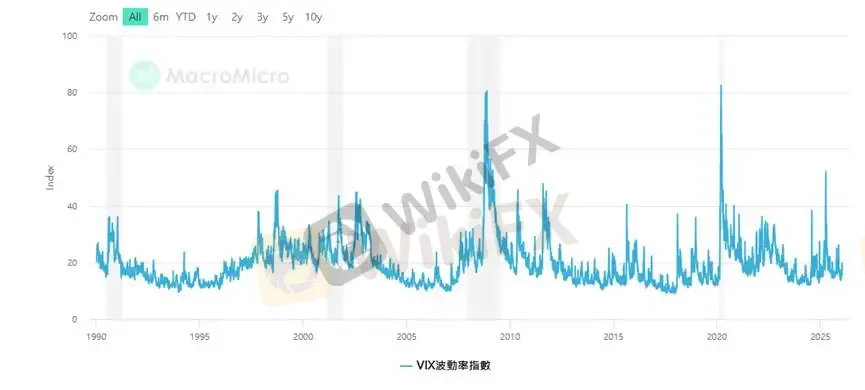
[Figure 2: VIX Volatility Index | Source: M Square]
Key Drivers Behind the Gold Rally
Political Uncertainty:The budget deadlock and enforcement-related protests have undermined confidence in the U.S. dollar. On Polymarket, betting volume has reached USD 7.5 million, pricing in shutdown risk. Historical precedent from the 2018–2019 43-day shutdown shows a clear rise in safe-haven premiums. Geopolitical overlays, including potential Canadian tariff threats and the Trump administrations softened immigration stance, have accelerated capital flows out of U.S. Treasuries and into gold.
Central Bank Buying Frenzy: Global central banks recorded net gold purchases of 634 metric tons in the first three quarters, well above pre-pandemic averages. Under a renewed trade-war environment in 2026, the probability of continued accumulation stands at 90%. Goldman Sachs has raised its year-end gold target to USD 5,400. Meanwhile, a potential government shutdown could delay key inflation data such as PCE, pushing the probability of a rate cut at the January 29 FOMC meeting to 40%. As opportunity costs approach zero, holding gold becomes increasingly attractive. On the supply side, surging demand from AI and defense sectors, coupled with mining constraints, is lifting the inflation baseline by 0.3%.
Gold Enters a Consensus Phase:Household allocation to gold remains well below historical peaks, suggesting further upside potential. However, a rising valuation anchor also signals overheating risks. The full price trajectory points to:
Short-term: USD 5,200 (shutdown trigger)
Mid-term: USD 5,400 (central bank buying + rate cuts)
Long-term: USD 6,000+ (erosion of dollar dominance + fiscal deficits)
[Figure 3: Gold H1 Hourly Chart Analysis]
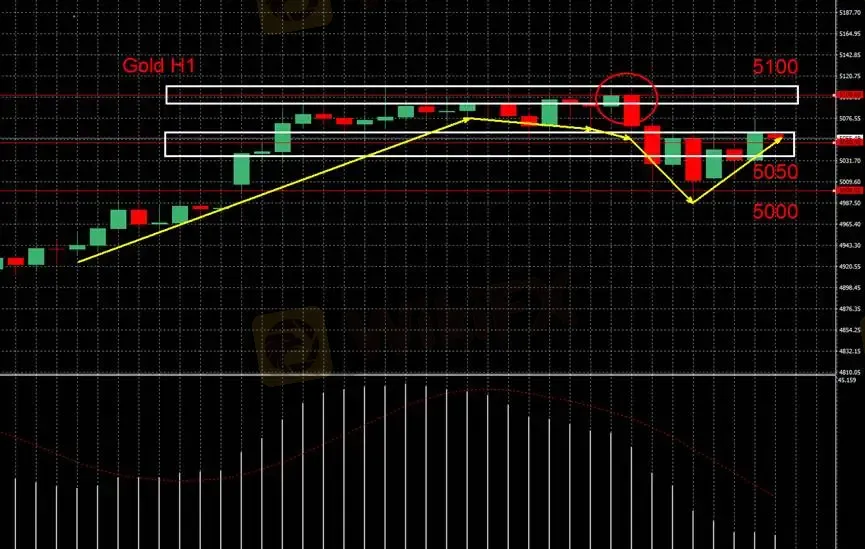
Given current conditions, chasing prices is not advisable. Instead, decisions should be anchored around key levels.
If prices hold above USD 5,000 and consolidate above USD 5,050, the bullish structure remains intact, with another test of USD 5,100 possible.
Conversely, a decisive H1 close below USD 5,000 would signal a breakdown of the bullish structure, shifting the market into a weakening, high-level consolidation phase and warranting a more defensive trading stance.
Risk Disclaimer:
The views, analyses, research, prices, and other information provided herein are for general market commentary only and do not represent the position of this platform. All readers assume full responsibility for any associated risks. Please trade with caution.
Haftungsausschluss:
Die Ansichten in diesem Artikel stellen nur die persönlichen Ansichten des Autors dar und stellen keine Anlageberatung der Plattform dar. Diese Plattform übernimmt keine Garantie für die Richtigkeit, Vollständigkeit und Aktualität der Artikelinformationen und haftet auch nicht für Verluste, die durch die Nutzung oder das Vertrauen der Artikelinformationen verursacht werden.
WikiFX-Broker
Aktuelle Nachrichten
Die Top 3 am besten regulierten Forex-Broker weltweit
 WikiFX
Krypto-Schock: Ethereum rutscht zweistellig ab – Anleger ziehen Milliarden ab
WikiFXDie Top 3 am besten regulierten Forex-Broker weltweit
WikiFXWenn du ein FX-Trader bist, könnten diese Broker genau das sein, wonach du gesucht hast.
WikiFXEthereum-Gigant kauft weiter zu – Milliarden-Wette auf Krypto
WikiFXDie Top 3 am besten regulierten Forex-Broker weltweit
WikiFXDie besten Plattformen für Forex-Trader, die auch investieren wollen
WikiFXCardano rutscht weiter ab – droht jetzt der nächste Absturz?
WikiFXLitecoin meldet sich zurück: Hoffnung auf Erholung über wichtiger Marke
WikiFXDNeue FX-Trader: Sucht nicht weiter – hier sind die 3 besten Broker für Anfänger
WikiFXWechselkursberechnung
USD

CNY
Aktueller Wechselkurs:0
Bitte geben Sie den Betrag ein
USD
Konvertierbarer Betrag
CNY
Berechnen