


Global Broker Regulation Inquiry App
About WikiFX
English
简体中文
繁體中文
English
Pусский
日本語
ภาษาไทย
Tiếng Việt
Bahasa Indonesia
Español
हिन्दी
Filippiiniläinen
Français
Deutsch
Português
Türkçe
한국어
العربية
اردو

U.S.-Iran Ceasefire Agreement Nears Completion as Strait Transit Fee Dispute Emerges
Abstract:[Chart 1: U.S.-Iran Ceasefire Negotiations]The U.S. and Iran are reportedly close to signing a ceasefire agreement after reaching consensus on a memorandum of understanding. However, disagreements ove
[Chart 1: U.S.-Iran Ceasefire Negotiations]
The U.S. and Iran are reportedly close to signing a ceasefire agreement after reaching consensus on a memorandum of understanding. However, disagreements over future transit fees in the Strait of Hormuz continue to create uncertainty regarding implementation.
U.S. Vice President Vance stated that the Strait should remain permanently open without transit charges, while Iran indicated it would allow free passage for only 60 days before introducing fees related to security and navigation services. Iran's Foreign Ministry also confirmed that nuclear negotiations and sanctions relief talks are expected to begin within 60 days of the agreement's signing.
Under the current draft, vessels would enjoy a temporary toll-free period, after which management of the Strait could be jointly coordinated by Iran and Oman. Market participants view references to “navigation services” as a sign that Washington may have partially accepted Iran's authority to impose certain charges.
Despite growing optimism, G7 nations remain cautious. U.S. officials estimate that shipping activity may take at least two weeks to recover meaningfully, while a full return to pre-conflict traffic levels could take considerably longer. Mine-clearing operations, elevated insurance costs, and shipping companies' risk assessments remain key obstacles.
Markets Rally on Peace Expectations
Financial markets have already begun pricing in a de-escalation scenario. During Asian trading hours, crude oil prices fell roughly 4%, while Japanese and South Korean equities posted strong gains. U.S. stock futures also moved higher, reflecting expectations of improved energy supply conditions and easing inflation pressures.
However, shipping industry groups continue to urge caution, noting that navigational safety cannot be fully guaranteed until all operational details are clarified.
Key Agreement Highlights
Ceasefire & Maritime Access
Immediate and permanent ceasefire upon signing.
Gradual restoration of commercial shipping activities.
Removal of U.S. maritime restrictions.
Nuclear Talks & Sanctions
Nuclear negotiations to begin during a second phase.
Iran expected to dilute portions of its highly enriched uranium.
The U.S. may release certain frozen assets and ease selected sanctions.
Regional Risks
Israel is not a party to the agreement.
Potential independent actions by Israel remain a key uncertainty.
Analyst's View
The upcoming U.S.-Iran ceasefire agreement represents the most significant de-escalation signal since the conflict began four months ago. A reopening of the Strait of Hormuz could reduce pressure on oil prices, improve inflation expectations, and provide greater policy flexibility for the Federal Reserve.
Nevertheless, several risks remain, including disputes over transit fees, the progress of nuclear negotiations, shipping confidence, and broader geopolitical developments.
In the short term, market attention will focus on the planned signing ceremony in Switzerland on June 19 and the pace at which maritime traffic returns to normal. While investors have largely embraced the prospect of peace, any unexpected setbacks could trigger renewed market volatility.
Gold Technical Analysis
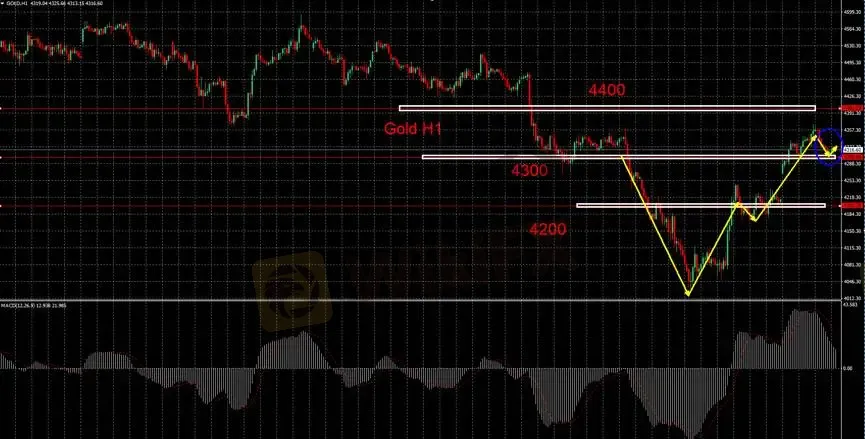
[Chart 2: Gold H1 Chart]
Gold remains in a short-term recovery phase on the hourly chart, trading around the 4,310-4,320 range. Price action shows a gradual upward bias, while resistance remains concentrated between 4,350 and 4,400.
The MACD indicator remains positive and continues to strengthen, suggesting improving bullish momentum in the near term.
Trading Strategy
Consider light long positions around 4,310-4,320
Stop loss below 4,280
Initial target: 4,360-4,380
Additional long positions may be considered if price breaks above 4,350 with strong volume
A move below 4,290 may warrant a neutral or cautious bearish stance
Risk Disclaimer
The information above is provided solely for general market commentary and does not constitute investment advice. Investors should make independent decisions and assume full responsibility for any trading risks. Proper risk management is strongly recommended.
Disclaimer:
The views in this article only represent the author's personal views, and do not constitute investment advice on this platform. This platform does not guarantee the accuracy, completeness and timeliness of the information in the article, and will not be liable for any loss caused by the use of or reliance on the information in the article.
WikiFX Broker
Latest News
Spotting Trend Reversals: How to Read Hammer and Engulfing Candlesticks
 WikiFX
Why Real Money Forex Trades Trigger Early Exits
WikiFXRM371,000 in Life Savings Lost After Trusting a Facebook Investment Ad
WikiFX$100 Million Fine, Deposit Delays and Customer Outrage: Is TIGER BROKERS Losing Traders' Trust?
WikiFXStockity Review 2026: Offshore Regulation, Complaints, and Withdrawal Risk Signals
WikiFXJapan raises interest rate to highest since 1995
WikiFXTrading the 24-Hour Currency Market on a 9-to-5 Schedule
WikiFXDollar Slips After Ceasefire Agreement
WikiFXForexDana Review 2026: Is This Forex Broker Safe?
WikiFXKraken Becomes FIFA World Cup 2026's Official Crypto Exchange | What It Means for Investors
WikiFXCurrency Calculator
USD

CNY
Current Rate:0
Enter amount
USD
Redeemable Amount
CNY
Calculate 