

Global Broker Regulation Inquiry App
About WikiFX
English
简体中文
繁體中文
English
Pусский
日本語
ภาษาไทย
Tiếng Việt
Bahasa Indonesia
Español
हिन्दी
Filippiiniläinen
Français
Deutsch
Português
Türkçe
한국어
العربية
اردو


ThinkMarkets Review 2026: Regulation Strengths, Withdrawal Complaints, and Trading Risks

WikiFX
|


Abstract:ThinkMarkets has a relatively high WikiFX Score of 7.75 and several named regulatory entries, including FCA, ASIC, CySEC, Seychelles FSA, Japan FSA, and South Africa FSCA, but the available data also shows offshore and unverified status markers. The core risk is not lack of information; it is the sharp contrast between strong-looking regulation data and a large cluster of recent withdrawal and account-handling complaints.
Executive Summary (TL;DR): ThinkMarkets is not a thin-profile broker in the WikiFX data: it was established in 2012, has a WikiFX Score of 7.75, an A influence rating, and an AA trading environment grade. But this review also has to treat the warning signs seriously, because WikiFX reports 80 user complaints in the past three months and the exposure cases include repeated claims of delayed withdrawals, frozen requests, deducted profits, poor support response, and platform execution problems.
Before you find a broker for Forex or CFD trading, you need to check more than the license list. In this ThinkMarkets review, the available WikiFX data presents a mixed picture: broad regulation coverage and solid trading-environment testing on one side, but a heavy complaint pattern on the other. If you are considering a deposit, the key question is not whether ThinkMarkets has visible credentials; it is whether the account entity, withdrawal route, and customer support process give you enough practical protection.
 Contents
Regulation and Safety
The WikiFX profile lists ThinkMarkets as an Australia-based broker established in 2012. Its safety data shows several regulatory entries: the UK Financial Conduct Authority, or FCA, under TF Global Markets (UK) Limited with license number 629628; the Australian Securities and Investments Commission, or ASIC, under TF GLOBAL MARKETS (AUST) PTY LTD with license number 424700; the Cyprus Securities and Exchange Commission, or CySEC, under TF Global Markets (Europe) Ltd with license number 215/13; and the South Africa Financial Sector Conduct Authority, or FSCA, under TF GLOBAL MARKETS (SOUTH AFRICA) (PTY) LTD with license number 49835. These entries are marked as regulated in the source data.
There is also a Seychelles Financial Services Authority entry for TF Global Markets Int Ltd, license number SD060, marked as offshore regulation. The Japan Financial Services Agency entry, under Asahi Markets Co., Ltd., is marked as unverified. That matters. A broker can have stronger and weaker entities at the same time, and your protection depends on the exact company that opens your account, not just the brand name on the website.
So the regulation status is mixed rather than simple. Stronger jurisdictions may offer more structured oversight, while offshore regulation can carry weaker client-protection expectations. An unverified status is also a signal to double-check documents before funding. If you are asked to open under an entity different from the one you expected, pause and verify it.
WikiFX Score and Visible Risk Signals
ThinkMarkets has a WikiFX Score of 7.75. Treat that as a live data point, not a permanent guarantee of safety. The broker also has an A influence rating and a trade environment rank of AA, with testing based on 375 users using VPS environments. Those are meaningful positives in the available data.
The risk side is hard to ignore. WikiFX states that complaints against ThinkMarkets reached 80 in the past three months. The profile advantages mention multiple financial regulators, a “Great” trading environment, and mainstream MT4/MT5 platforms. The listed disadvantages include questionable regulatory status, multiple exposure records, and a high number of customer complaints. For you, this means the broker may look operationally established, but recent user experience reports should be checked before any new deposit.
Trading Conditions
ThinkMarkets lists three account types: Standard, ThinkTrader, and ThinkZero. The Standard account shows a $250 entry condition, maximum leverage of 1:500, and spreads from 0.4. The ThinkTrader account shows a lower $50 entry condition but much higher maximum leverage of 1:2500, with spreads from 0.4. The ThinkZero account shows a $500 entry condition, leverage up to 1:500, and spreads from 0.0.
The available product range includes Forex, commodities, indices, crypto, stocks, ETFs, and futures, depending on the account type. For Forex trading costs, the trade environment data is fairly detailed: the cost grade is AAA, average cost for one tested instrument is shown as 0.0, and average gold cost is 1.31. Still, high leverage deserves caution. Leverage of 1:500 is already aggressive for many retail traders; 1:2500 can magnify losses extremely quickly if execution, margin, or volatility moves against you.
The trading environment test gives a broad “Great” result and an AA grade, but not every sub-score is excellent. Speed is graded B, slippage is graded B with an average slippage of 1.0 and maximum slippage of 3.0, while the text label also describes slippage as poor. Swap is graded C and described as poor. In plain English: headline trading conditions look competitive, but holding costs and slippage deserve attention, especially if your strategy depends on precision execution.
Platform and Account Access
The platform data is one of ThinkMarkets stronger areas. WikiFX lists proprietary software, MT4, and MT5, with support for mobile, desktop, and web access. The tested platform was MT5, described as highly customizable, multilingual, and supported by clear fee reports. The software qualification is marked as mainstream MT4/5, and available downloads include ThinkCopy, ThinkPortal, and ThinkTrader across Android, iOS, Windows, web, and macOS.
There is one account-access issue worth noting from the source data: the MT5 review says the platform lacks two-step login and biometric authentication for safer login. That is not the same as saying users had login failures, and no login outage is stated in the data. It simply means you should be careful with account security. Use the official website or listed app links only, avoid entering credentials through unofficial pages, and keep email and device security tight.
Trader Complaints and Exposure Cases
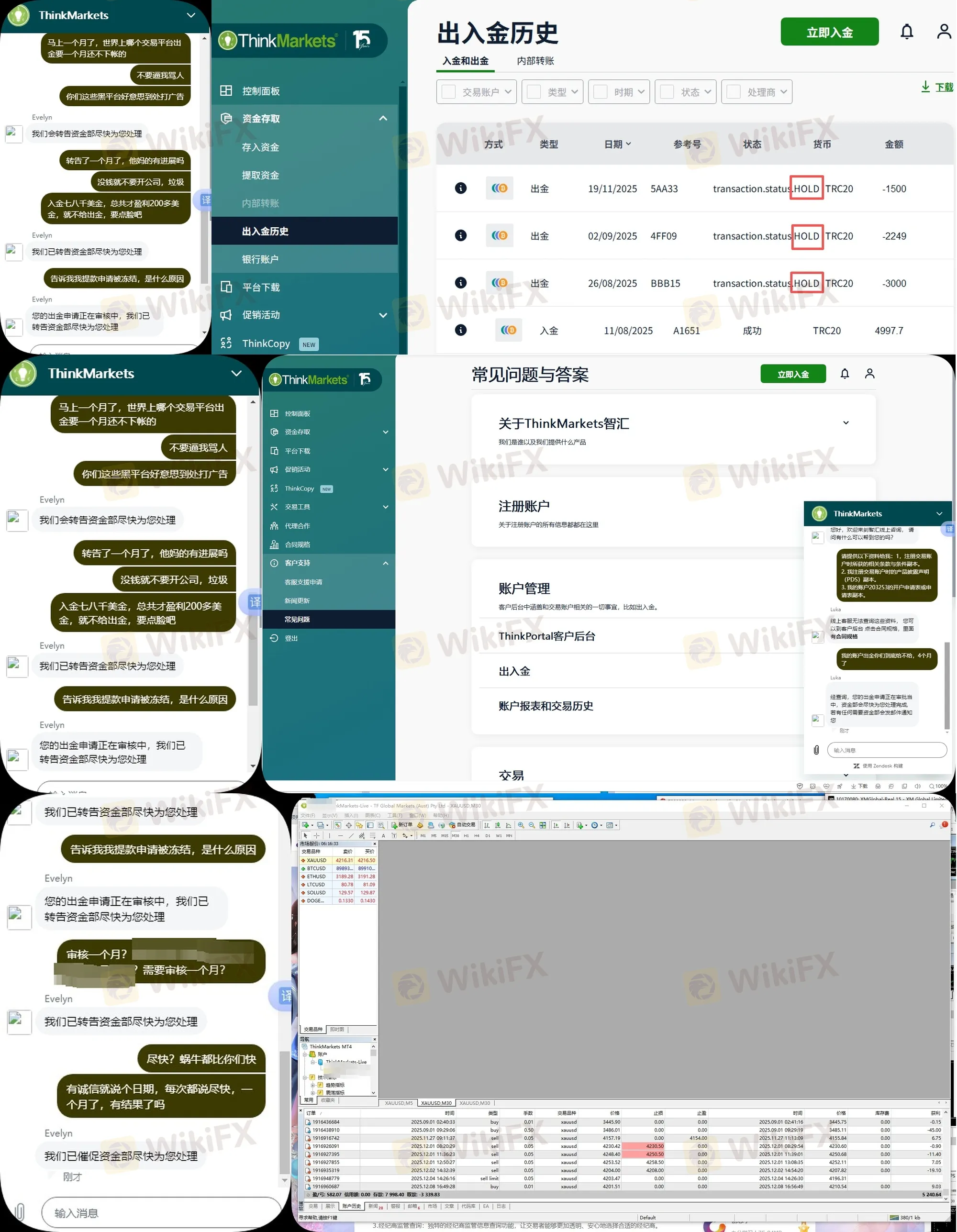
The exposure cases show a clear pattern: many users complain about withdrawals being delayed, frozen, rejected, or left “under processing” for long periods. One Italy case dated June 8, 2026 says the user had been unable to withdraw since the previous September and received repetitive responses by email and back-office customer service. A China case dated January 28, 2026 says a withdrawal had not been processed for a month and the reply was always that it was being handled.
Several cases provide amounts. In December 2025, one user said they deposited $7,998.40, withdrew $3,339.883 earlier, then had a remaining balance of $5,240.64 while withdrawal requests since August 26 were allegedly frozen.
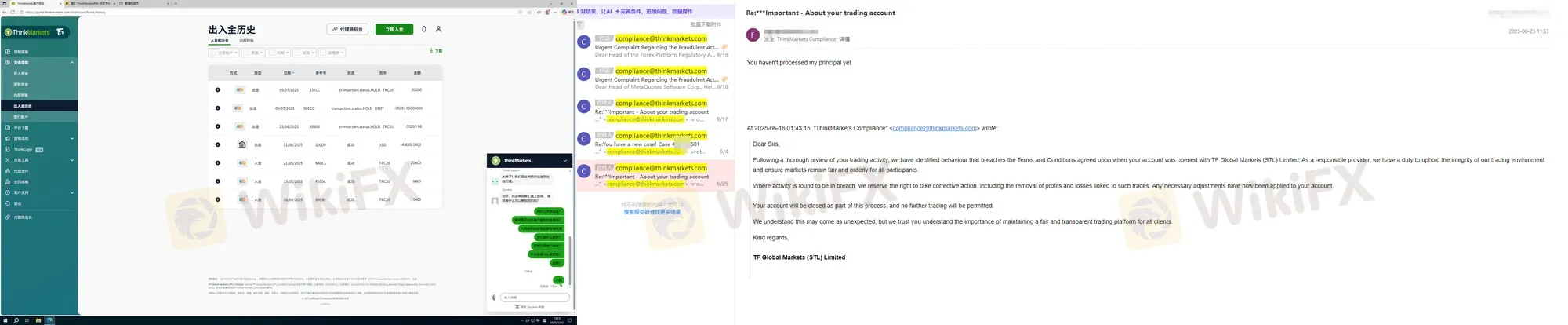
Another December 2025 case claimed a $30,000 deposit, profit of $43,685, and a platform email alleging illegal activity before adjusting the balance and closing the account, while the user said even the principal had not been withdrawn for three months.
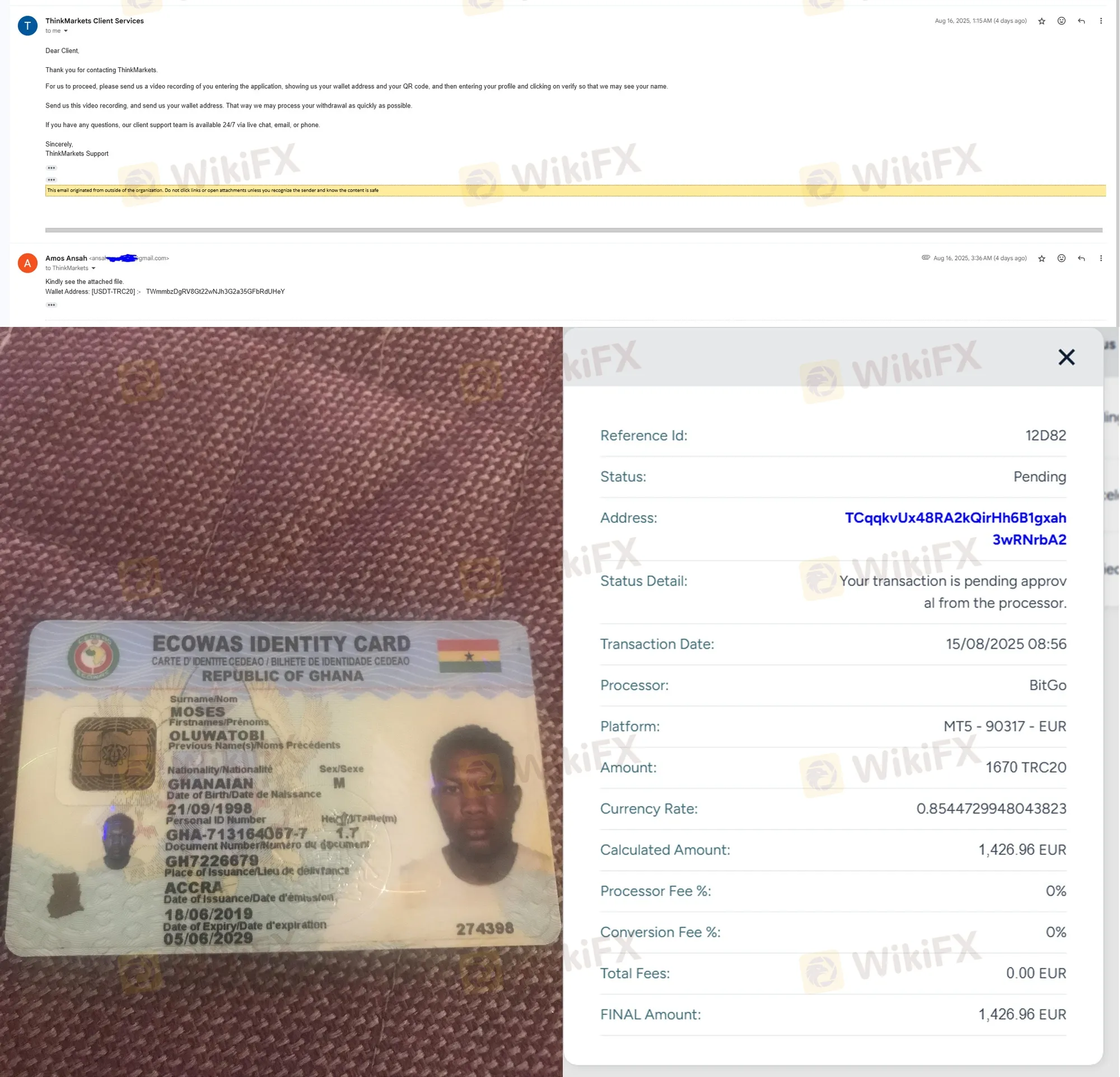
The complaints are not limited to one region. A Ghana case in August 2025 described a crypto withdrawal pending for more than five days despite requested recordings being provided, with support saying the matter had been forwarded to finance and finance emails unanswered.
Other cases from Hong Kong, Taiwan, mainland China, Egypt, Iraq, and Malaysia mention delayed withdrawals, deducted profits, account closure, severe slippage, spread or chart manipulation allegations, failed order closing, and poor customer-service response.
These are user allegations, not a court finding. But the repetition is the point. If many reports describe the same operational pain point, you should test withdrawals early with a small amount, keep screenshots, save email trails, and avoid building a large balance until the withdrawal process has been proven in your own account.
Deposits, Withdrawals, and Support
The highlighted funding methods include Neteller, Skrill, UnionPay, and bank wire. Customer service is listed across multiple languages and channels, including phone, email, and social platforms. The source data says users can receive most relevant answers, but waiting times may be long.
That detail fits the complaint pattern: many users say support repeatedly referred them to a finance department, asked them to wait, or stopped replying by email. If you use this broker, document every deposit and withdrawal request. Do not rely only on live chat; keep written records that can be used if you need to escalate.
Final Verdict: Should I open an account?
ThinkMarkets has visible strengths: multiple regulatory entries, a long operating history since 2012, MT4/MT5 support, several account types, and a strong WikiFX trading-environment grade. At the same time, the risk level is elevated by the number and consistency of recent withdrawal-related complaints, plus mixed regulation markers including offshore and unverified status.
If you still want to try it, start small, verify the exact legal entity, test a withdrawal before scaling, and avoid assuming that a high score or famous regulator name automatically protects your specific account. Status changes daily. Before depositing, check the WikiFX App for the latest real-time certificate.

Disclaimer:
The views in this article only represent the author's personal views, and do not constitute investment advice on this platform. This platform does not guarantee the accuracy, completeness and timeliness of the information in the article, and will not be liable for any loss caused by the use of or reliance on the information in the article.
WikiFX Broker
Latest News
Singapore tightens monetary policy in surprise move as rising oil prices rekindle inflation risk
WikiFXSPREDIX MARKETS Review: What Traders Should Know Before Depositing
WikiFXBXB Review – Zero Regulation, Dead Website: What Traders Need to Know
WikiFXHFM Review: No Regulatory Licences and a 1.83 Score , Is Your Deposit Safe?
WikiFXIs Your Withdrawal Plan Killing Your Compounding Gains?
WikiFXHFMARKETS TRADE Review: Zero Regulation and a Central Bank Warning
WikiFXWinvest Review: What Traders Should Know Before Depositing
WikiFXTrade Nation Review: What Traders Should Know Before Depositing
WikiFXFXPesa Review: Is Your Deposit Safe?
WikiFXXM Royal Scam Drains RM119,599 From Malaysian Housewife
WikiFX