


Global Broker Regulation Inquiry App
About WikiFX
English
简体中文
繁體中文
English
Pусский
日本語
ภาษาไทย
Tiếng Việt
Bahasa Indonesia
Español
हिन्दी
Filippiiniläinen
Français
Deutsch
Português
Türkçe
한국어
العربية
اردو
Why Catching Tops and Bottoms Ruins Beginner Forex Accounts
Abstract:For beginner Forex traders, trying to guess the exact market bottom or top is a fast track to wiped-out accounts. This article explains the difference between left-side and right-side trading, why indicators often trap counter-trend traders, and how to safely navigate market trends.
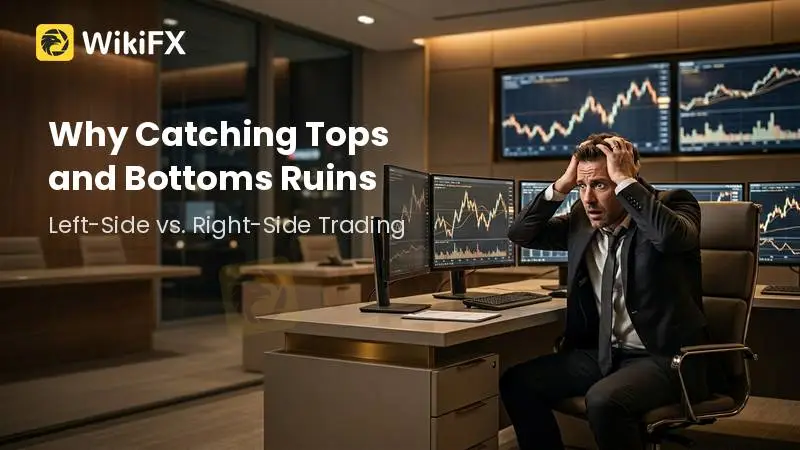
Many new traders look at a falling price chart and think, “It can't possibly go any lower.” They buy in, hoping to catch the absolute bottom, only to watch the price crash even further.
This habit of picking tops and bottoms—often called counter-trend trading—is one of the most common ways beginners in Malaysia and around the world wipe out their trading accounts. In a fast-moving Forex market, trying to fight a strong trend is rarely a strategy; it is usually just gambling in disguise.
 Contents
Left-Side vs. Right-Side Trading Explained
In the market, your entry timing generally falls into two styles: left-side and right-side trading.
Left-side trading means you buy before the price reaches its absolute lowest point, or sell before it hits the very peak. You are trying to predict the exact moment the market will turn. The appeal is obvious—if you are right, your profit margin is massive. The problem is that you might buy the “bottom,” only to find out there is a basement underneath it.
Right-side trading means you wait. You let the price hit the bottom, curve back up, and only buy when the new upward trend is confirmed. While you miss the very start of the move, this method is significantly safer. For beginners trading with smaller capital, right-side trading is generally the smarter choice because it actively reduces the risk of getting run over by an ongoing trend. You enter the market only when the price has proven it is moving in your direction.
The Trap of “Overbought” and “Oversold”
A major reason traders fail at picking tops and bottoms is because they blindly trust technical indicators like the Stochastic oscillator or KDJ. These tools measure momentum and tell you when a currency pair is “overbought” (time to sell) or “oversold” (time to buy).
However, if a massive trend is happening, these indicators will lie to you. For example, during a strong, year-long upward run in the USD/JPY pair, the Stochastic indicator might scream “overbought” for months at a time. If you keep selling purely because the indicator line crossed the 80 mark, you will be squeezed out of your positions repeatedly.
This is why indicators like the ADX (Average Directional Index) exist. They measure the pure strength of a trend. When a trend is incredibly powerful, you must ignore the standard overbought warnings and stop trying to pick the top.
Looking at the Bigger Picture
So, how do you avoid entering trades at the worst possible time?
First, step back and examine the weekly charts. A daily chart might look like a great place to buy a dip, but the broader weekly chart could reveal a massive, unforgiving downtrend. Looking for “cross-resonance”—where both the weekly and daily charts signal a buy at the exact same time—is a highly effective way to filter out false signals.
Second, wait for confirmation when you see a divergence. A “divergence” happens when the price makes a new low, but your indicator makes a higher low. It is a reliable warning that the downward trend is losing steam. But remember: a divergence is just a warning sign, not a green light to buy immediately. The price could just enter a brief consolidation phase before dropping again. Always wait for a secondary signal, like a trendline break or a candlestick pattern, to confirm the trend has actually changed direction.
Ride the Wave
A good trade should never feel like trying to catch a falling knife. Instead of trying to outsmart the market by guessing where the tops and bottoms are, let the trend establish itself and simply ride along. Your job is to extract a sensible profit from the middle of the price move, not to be a hero at the extreme edges.
As you refine your strategy to trade with the trend, it is equally important to make sure your trading environment is safe. You can use the WikiFX app to verify your broker's regulatory status and background to ensure you are trading on a trustworthy platform. That way, you can focus entirely on reading the market, rather than worrying about the safety of your funds.

Disclaimer:
The views in this article only represent the author's personal views, and do not constitute investment advice on this platform. This platform does not guarantee the accuracy, completeness and timeliness of the information in the article, and will not be liable for any loss caused by the use of or reliance on the information in the article.
WikiFX Broker
Latest News
EMAR MARKETS Review 2026: Complaints, High Leverage, and Withdrawal Risk Signals
 WikiFX
EMIRAX MARKETS Review 2026: Unregulated Status, High Leverage, and Withdrawal Complaints
WikiFXHow the Bullet Theory Fixes the Habit of Overtrading
WikiFXReview 2026: Interactive Brokers Regulation, Complaints, and Platform Access
WikiFXReview 2026: STMARKET Regulation, MT5 Access, and Withdrawal Complaint
WikiFXOver 100 Malaysian Retirees Gather to Expose How Investment Scams Wiped Out Their Life Savings
WikiFXSquaredFinancial Review 2026: Heavy Complaints, Withdrawal Delays, and Profit Deletions
WikiFXUbuntu Invest Review 2026: Is This Forex Broker Safe?
WikiFXVonway Forex Review 2026: Withdrawal Complaints, Regulation Warnings, and Account Risks
WikiFXStructuring a Practical Forex Trading Plan and Stop-Loss Strategy
WikiFXCurrency Calculator
USD

CNY
Current Rate:0
Enter amount
USD
Redeemable Amount
CNY
Calculate 